
Photo: Dllu · CC BY-SA 4.0
Spam Musubi (Grilled Luncheon Meat Rice Block)
Hawaii's everyday snack: a block of pressed rice, a slab of luncheon meat glazed in soy and sugar, and a band of nori wrapped around both. Three ingredients, so it looks like assembly, and the reason it is still worth eating hours later at room temperature comes down to two treatments — glazing the meat rather than merely frying it, and pressing the rice while it is hot so it sets instead of falling apart when cold.
Ingredients
- Rice (makes 8)
- short-grain rice · japonica; it needs the stickiness to hold together2 cups
- water2 cups
- rice vinegar · optional, if they are to sit out for hours1 tbsp
- salt0.5 tsp
- Meat and glaze
- luncheon meat · 340g, sliced 8-10mm thick1 tin
- soy sauce3 tbsp
- sugar · reduced down for the gloss2 tbsp
- mirin · or sake with a little extra sugar1 tbsp
- oil1 tbsp
- To finish
- roasted nori · cut in half lengthways, 8 bands4 sheets
- furikake · optional, between rice and meat2 tsp
- sesame oil · optional1 tsp
Steps
- ⏲ 10 min
Rinse and cook the rice. Let it stand covered 10 minutes, then fold through the salt and vinegar with a cutting motion. Use the rice hot — cold rice will not bond to itself however hard you press, and the block falls apart as you lift it.
Turn the luncheon meat out and cut 8-10 slices 8-10mm thick. Thinner and they break up in the glaze; thicker and the ratio to the rice is wrong. Keep the tin and wash it — it works as the mould for pressing the rice.
- ⏲ 3 min
Fry the slices in a little oil over medium heat, 3 minutes a side, until the edges are deeply browned. The meat is already cooked, but this browning is what turns a tin of salt into something worth eating.
- ⏲ 2 min
Mix the soy, sugar and mirin, pour it into the pan and reduce 2 minutes, turning the slices so both faces take the glaze as it thickens. Do not let the pan go dry — burnt sugar tastes bitter.
Line a musubi mould, or the washed tin, with cling film, add warm rice and press it down firmly with a tool rather than your fingers — about 2cm thick, the same footprint as the meat. This pressing is what decides whether it holds once cold.
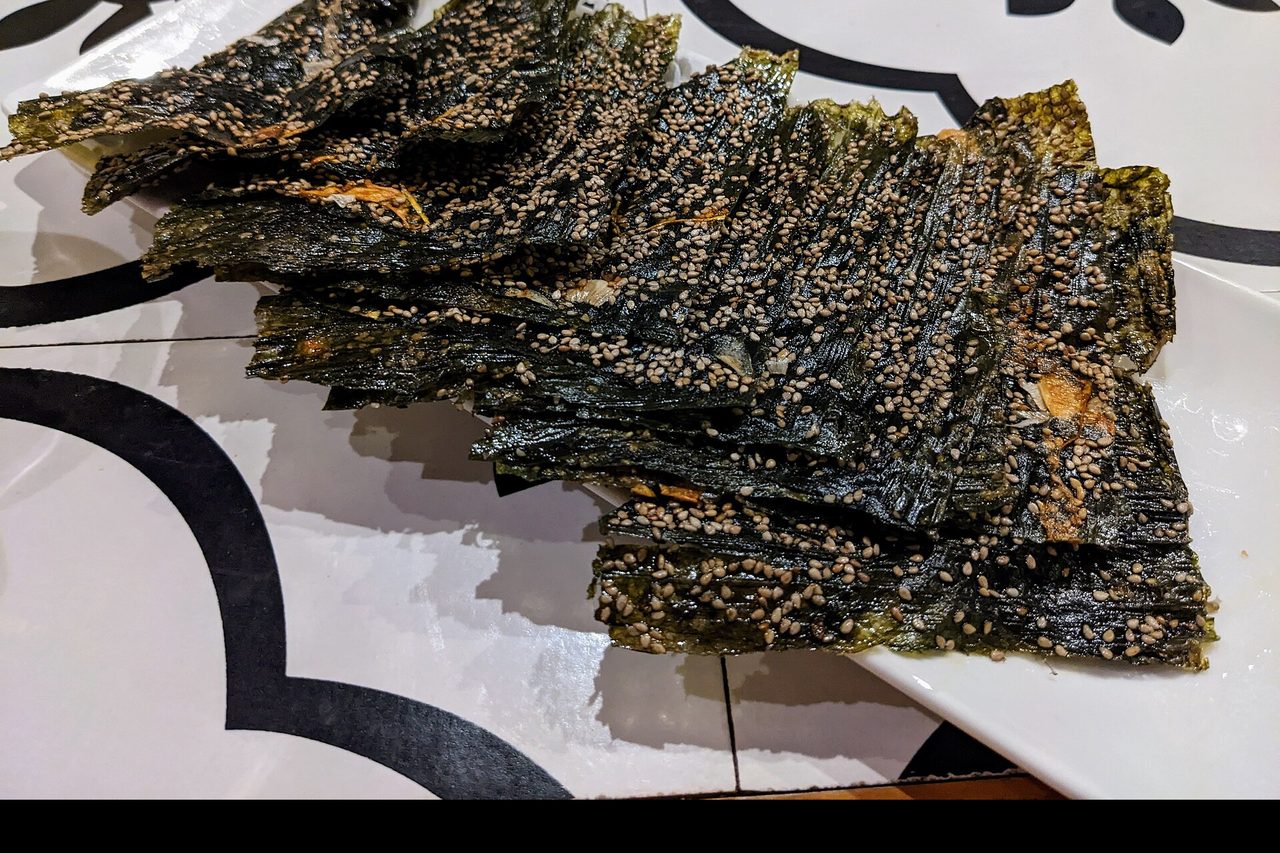
Scatter furikake over the rice, lay a glazed slice on top and push the block out of the mould. Wrap a band of nori from underneath and seal it by pressing a few grains of rice onto the overlap. Use the nori dry; do not wet it.
- ⏲ 20 min
Wrap each one tightly in cling film and leave 20 minutes. In that time the nori takes up moisture from the rice, softens and binds the whole thing together. Eaten straight away the nori is stiff and separates from the rice as you bite.
Eat at room temperature. Do not refrigerate — the starch in the rice sets hard and goes chalky, and reheating never fully undoes it. This is same-day food.
Tips & Variations
Variations
- With egg: a thin omelette laid between the meat and the rice, standard in Hawaii's convenience stores, and it takes the edge off the salt.
- Teriyaki style: ginger and garlic in the glaze makes it the same sauce as teriyaki chicken. In Hawaii that is arguably the more standard version.
- Kimchi musubi: chopped kimchi folded into the rice, a combination that came out of Hawaii's Korean community — the same idea as kimchi fried rice.
- How it differs from onigiri: ko.wikipedia records the Japanese rice ball as its ancestor, but the structure is not the same. Onigiri hides a filling inside rice shaped by hand into a triangle; musubi presses rice into a rectangular block, puts the filling on top, and ties the two together with nori. It is built more like a sandwich.
- Why Hawaii: tinned luncheon meat arrived as US military supply across the Pacific during the Second World War and stayed afterwards, meeting the rice-ball format of the Japanese immigrant community. In Korea the same tin went into budae-jjigae — the same route exactly, a completely different result.
- The other Hawaiian one: with poke, it is one of the two things the islands eat every day.
- As a packed lunch: wrapped, it survives half a day in a bag — the slot filled by tamago sando or gimbap.
Tips
- Glaze the meat, do not merely fry it. Straight from the tin it is salt and fat. Browning builds flavour and a reduced soy-and-sugar glaze coats it into something else entirely. Those two steps are most of this dish (browning and Maillard, what sugar does).
- Press the rice while it is hot. Freshly cooked, the starch on the surface of each grain is still tacky and the grains bond; cold, that property is gone and no amount of pressing brings it back (cooking rice).
- Press with a tool, not your fingers. By hand the pressure is uneven and one end ends up dense. With no musubi mould, the washed tin with both ends cut out is exactly the right size.
- Do not press too hard, either. Compacted to a paste, the grain structure disappears and there is nothing to chew. Firm enough to lift without collapsing is enough.
- Wrap the nori dry. Wetting it makes that patch soggy while the rest stays stiff. Moisture from the rice softens it by itself within twenty minutes.
- Those twenty minutes are cooking, not waiting. The nori bonds to the rice and a little of the glaze soaks in. It is definitively better twenty minutes on than straight away (serving temperature).
- The tablespoon of vinegar is for keeping. Add it if they are going to sit out. It does not need to taste like sushi rice; one tablespoon is enough to lower the pH (vinegar, salt and seasoning).
- Never refrigerate them. The starch recrystallises and the rice goes chalky. Where lamington is a recipe that relies on exactly that process, musubi is one it ruins — the same chemistry working in opposite directions (reviving leftovers).
- Wrap each one separately. They do not stick to each other, and peeling the film halfway keeps rice off your hands — which is precisely how they are sold in Hawaii.
- The ratio of thicknesses decides it. 2cm of rice to 1cm of meat is the benchmark. Thinner meat and it reads as salt; thicker and it cloys.
- With a reduced-salt tin, increase the glaze. Add a little more soy to make up the difference or it will not balance the rice (balancing flavour, soy sauce).
The basics behind this dish
- Cooking Rice: Rinsing, Ratios, and RestingHow far you rinse, how much water, and the ten minutes of resting decide the texture. And for fried rice or risotto, the rules invert.
- Eggs: Coagulation Temperatures and What They DecideWhite sets at 62°C, yolk at 68°C. Those two numbers explain scrambled eggs, boiled eggs, steamed custard and crème anglaise all at once.
- Reviving Leftovers: Reheating by Texture, Not by DefaultThe microwave is not the right tool for everything. What you do depends on what degraded — moisture, crispness, or starch — and the three want opposite treatments.
More of the same kind



More from this country




Sign in to edit.
AI-drafted, editor-reviewed · edits: 0 ·Edit history
https://cookiki.com/en/r/spam-musubi · cookiki · User contributions are licensed under CC BY-SA 4.0.