
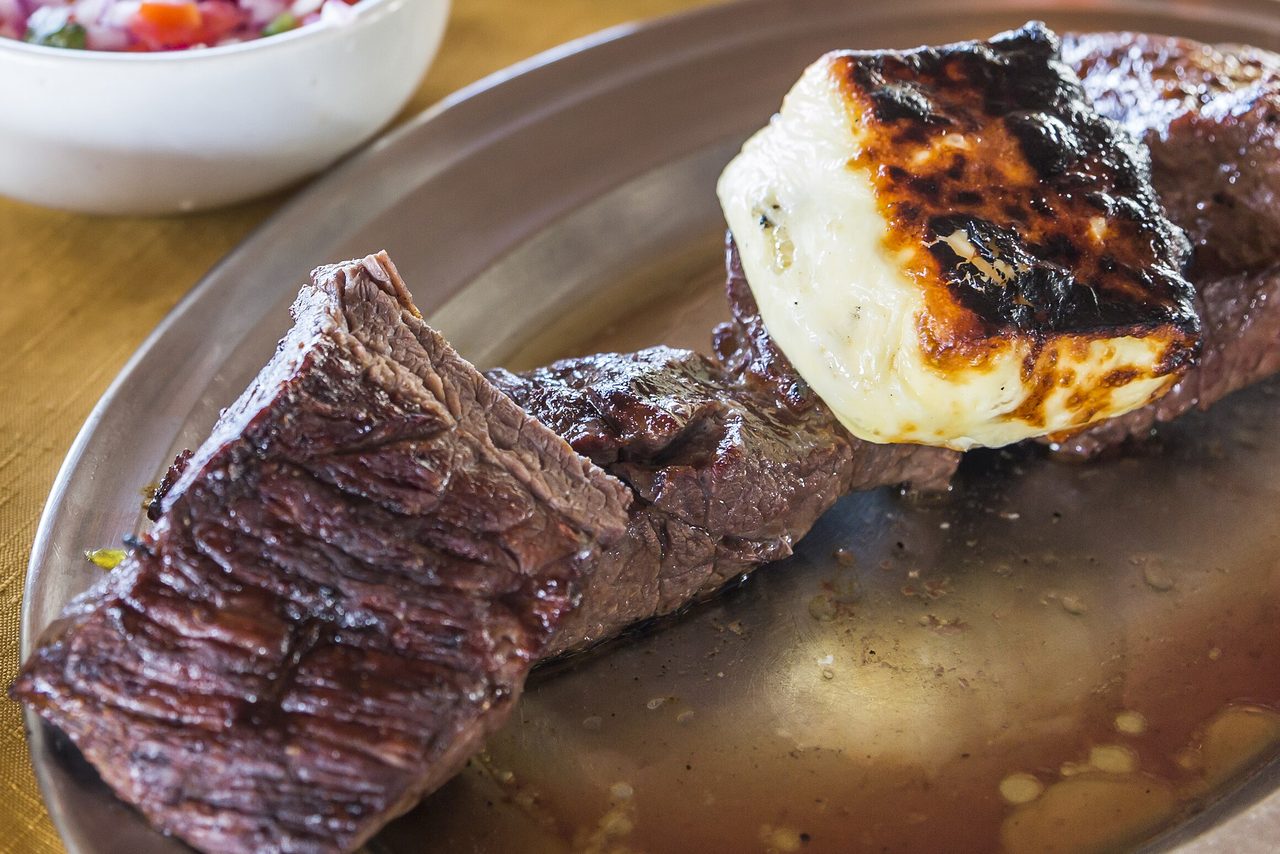
Photo: Luca Mascaro · CC BY-SA 2.0
Bistecca alla Fiorentina (Florentine T-Bone Steak)
Florence's T-bone steak: a cut from the loin with the fillet on one side of the bone and the sirloin on the other, 5-6cm thick, grilled over embers that have stopped flaming. It goes on with no salt and no oil, is turned once to build the crust, and finishes standing upright on its bone so the meat by the bone cooks through. The centre is rare, 50-52°C. Salt and olive oil go on after it comes off the fire.
Ingredients
- Meat
- T-bone steak · one piece 5-6cm thick; dry-aged two weeks or more if possible1.2 kg
- After grilling
- coarse salt · or flaky salt1 tbsp
- extra-virgin olive oil2 tbsp
- black pepper · optional1 pinch
- Fire
- hardwood charcoal · lump charcoal; avoid briquettes that smell of lighter fluid3 kg
- To serve
- cooked cannellini beans · dressed with olive oil and salt only400 g
- salad leaves · instead of the beans if you like1 handful
Steps
- ⏲ 60 min
Take the steak out of the fridge 1 hour before grilling and pat the surface thoroughly dry. No salt and no oil.
- ⏲ 40 min
Light plenty of charcoal and wait 30-40 minutes, until the flames have gone and every piece is coated in white ash. Bank it deep on one side and spread it thin on the other, so there is a hot zone and a gentle one.
- ⏲ 5 min 30 sec
Lay the steak over the hot side with the fillet (the smaller side of the T) facing the thin coals. Leave it 5-6 minutes, until a deep brown crust has formed, then turn it once, with tongs.
- ⏲ 5 min 30 sec
Give the second side 5-6 minutes. If dripping fat sets off flames, move the steak off that spot for a moment.
- ⏲ 6 min 30 sec
Move the steak to the gentle side and stand it up on the flat base of the T-bone. Leave it 5-8 minutes so the meat along the bone cooks through. Take it off when the thickest part reads 48°C.
- ⏲ 5 min
Rest it on the board for 5 minutes, while the centre climbs to 50-52°C.
Run a knife along the bone to lift off the fillet and the sirloin, and slice each across the grain about 1.5cm thick. Reassemble them beside the bone, scatter with coarse salt, pour over the olive oil, add pepper if you like, and serve at once with the beans.
Variations
- Sirloin only, off the bone: easier to cook, but not a fiorentina. The name means the T-bone and the two muscles on either side of it, together.
- The beef: traditionally Tuscany's Chianina breed. With another breed the thickness and the doneness stay the same.
- On the side: in Florence, white beans dressed only with olive oil, or a green salad. No sauce.
More detail and the reasons why (1)
- Oven and pan: without a charcoal fire, bring the centre slowly to 42-46°C in a low oven (about 90°C), then colour each face for 1-2 minutes in a smoking-hot cast-iron pan. It is the order in the tips turned round, and it leaves a thinner grey band under the crust.
Tips
- No oil either. Fat dripping onto coals flares, and the flames leave soot on the meat (grilling). The steak's own fat is enough; the olive oil is for flavour, on the plate.
- Wait for the flames to go. Charcoal under a coat of white ash gives steady radiant heat. Over live flames the outside burns while the centre stays cold.
More detail and the reasons why (6)
- This steak is cooked in the opposite order to the usual rule. Thick meat normally comes up on the cool side and takes its colour on the hot side at the end; the other way round, the outside burns before the middle is done (grilling). The Florentine way is the other way round: crust first. It gets away with it because of the next step, which moves the rest of the cooking off the two flat faces and onto the bone.
- Standing it on the bone is what rescues the order. Upright, the steak meets the coals with the base of the T-bone rather than with its broad faces, which are already brown. They stop cooking, and the meat beside the bone, the thickest part and the last to cook, gets the final minutes. The oven-and-pan variation solves the same problem the usual way round.
- One cut, two muscles. The fillet on one side of the bone is small and lean and cooks first; the sirloin on the other is larger and edged with fat. So the hot zone and the gentle one are used inside a single piece: turn the fillet towards the thin coals.
- Rare is the definition of the dish. A centre of 50-52°C is what rare means for beef (cooking meat). At this thickness the centre climbs a few degrees while it rests, so it comes off at 48°C. Cooked through, it is a different dish.
- Salt after, not before. The good moments to salt meat are just before it cooks or 40 minutes or more ahead; the 10-20 minutes in between are the worst, because the surface is beaded with water (salt and seasoning). Florence keeps the salt away from the fire altogether. The surface goes onto the coals dry, and since salt would not reach the middle of a 5-6cm steak anyway, coarse salt goes on the cut faces.
- The hour out of the fridge is for drying the surface. At this thickness an hour at room temperature barely moves the centre. What it does do is leave a dry surface, which browns faster (browning). Turning it only once, with tongs, protects the same surface.
The basics behind this dish
- Browning and the Maillard ReactionMeat fails to brown for one of three reasons: it is wet, the pan is cool, or you put too much in at once. Plus how the brown film stuck to the pan becomes your sauce.
- Cooking Meat: Temperature, Resting, and Cutting Against the GrainDoneness is a core temperature, not a number of minutes. What resting actually does, how to handle a thick cut, and why the direction you slice changes the texture.
- Knife Skills: Grip, Cuts, and Why Size MattersHow you hold the knife matters more than how fast you cut. The pinch grip, the claw hand, and why uniform size is a cooking decision rather than a cosmetic one.
More of the same kind


More from this country


Sign in to edit.
Written with AI · how we check it · Edit history
https://cookiki.com/en/r/bistecca-alla-fiorentina · cookiki · User contributions are licensed under CC BY-SA 4.0.