
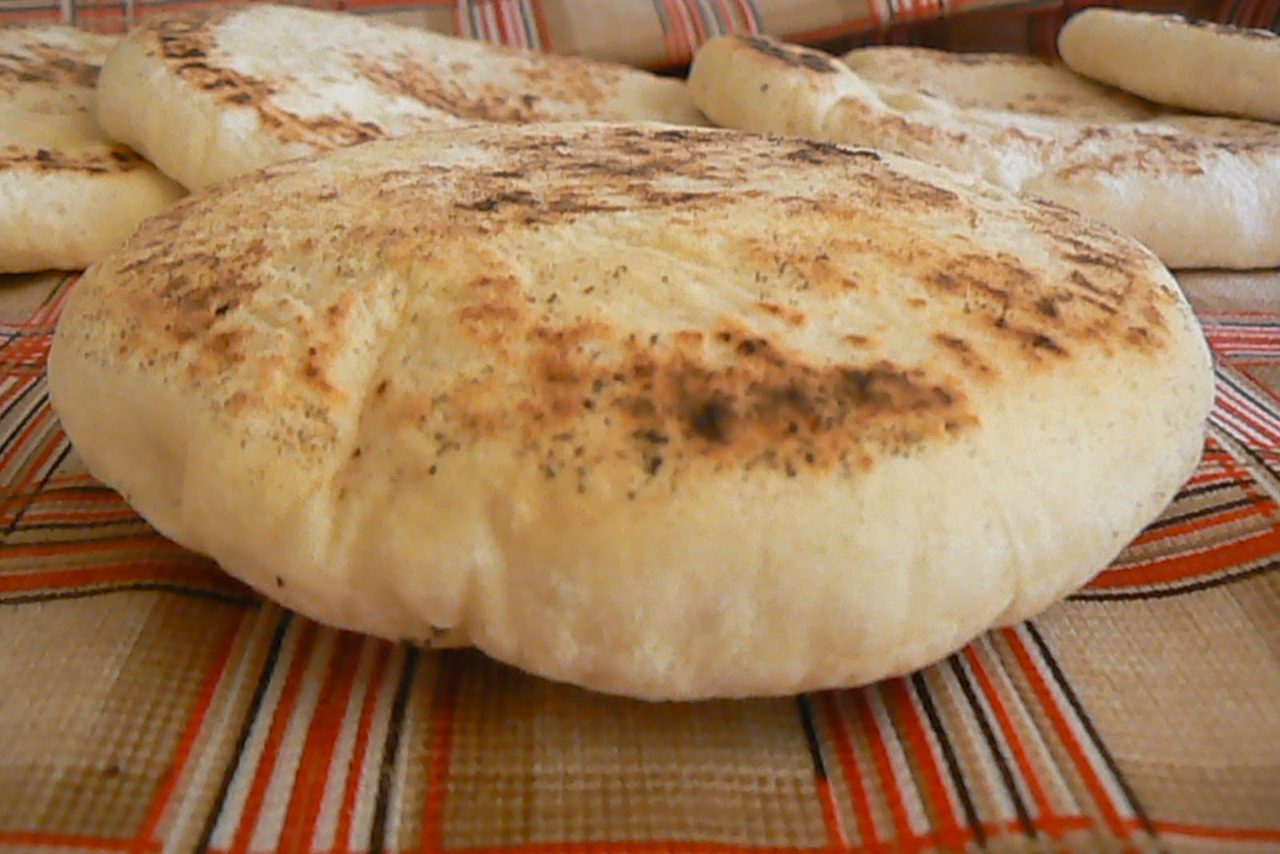
Photo: Ji-Elle · CC BY-SA 3.0
Gözleme (Thin Filled Flatbread from the Griddle)
A Turkish flatbread: a dough of flour, water and salt with no yeast and no fat, rolled out to about a millimetre, filled with spinach and cheese, folded, and cooked in a few minutes on a dry iron griddle. Chapati is the same unleavened dough and its whole point is that steam balloons it into a sphere. A gözleme has a filling in the way, so that cannot happen at all. With nowhere to expand, the heat only gets through by conduction — which is why the dough has to be rolled to paper and why the filling has to be cooked already.
Ingredients
- The dough
- plain flour400 g
- water · lukewarm; 60 percent hydration240 ml
- salt1 tsp
- olive oil · optional; it makes the rolling a little easier1 tbsp
- Spinach and cheese filling
- spinach400 g
- feta or beyaz peynir · crumbled200 g
- onion · finely chopped1
- salt · used to draw the water out of the spinach1 tsp
- black pepper0.5 tsp
- pul biber · optional1 tsp
- Other fillings
- minced beef · cooked with onion and cooled completely300 g
- potato · boiled, mashed, seasoned with cumin400 g
- To finish
- unsalted butter · brushed on after it comes off the griddle, never into the pan50 g
- lemon1
Steps
- ⏲ 30 min
Mix the flour, salt and water, knead ten minutes and rest it covered for at least half an hour. Dough and gluten says that dough fighting you as you roll is a time problem, not a strength problem; here that rest is the difference between one millimetre and three.
- ⏲ 15 min
Chop the spinach, salt it, leave it fifteen minutes and squeeze it dry by hand. Steam has nowhere to go inside this dough, so a wet filling tears it.
- ⏲ 10 min
Mix the squeezed spinach with the onion, crumbled cheese, pepper and pul biber. If you are using the meat or potato filling, it goes in completely cold.
- ⏲ 20 min
Divide the dough into six and roll each one out to about 40cm across and close to 1mm thick — thin enough to read newsprint through. If it tears, rest it another thirty minutes.
- ⏲ 10 min
Spread the filling thinly over the lower half, fold the top over it, then fold again into roughly a square. Press the edges together with your hands.
- ⏲ 5 min
Heat a cast-iron pan or a sac over a medium flame. No oil goes in. Fat under a 1mm sheet fries it into something glassy that cracks, and it has to stay foldable enough to hold.
- ⏲ 5 min
Cook it on the dry pan, two to three minutes a side. It is done when dark blisters appear on the surface and the cheese has melted inside. Do not wait for it to balloon — with a filling in it, it will not.
- ⏲ 2 min
Take it off and butter it then, while the surface is hot enough to absorb it. Cut into squares and serve with lemon.
Tips & Variations
Variations
- Fillings: besides spinach and cheese, minced meat, potato with cumin, mushroom, plain crumbled cheese with parsley. A Turkish market stall or a motorway stop will usually have six laid out.
- Bazlama: the cousin from the same kitchens — yeasted, 2cm thick, baked plain and not filled. If gözleme is the thin folded bread, bazlama is the thick sliced one.
- The sac: traditionally a convex iron plate set upside down over a wood fire. Being convex, the heat spreads from the middle, and finished breads are pushed to the rim to stay warm.
- Yufka: the same dough rolled large without filling and dried is yufka — the sheet su böreği is built from.
Tips
- It is the inverse of chapati. That bread is the same unleavened dough and its whole point is ballooning on the fire and pulling apart into two layers. A gözleme has a filling between those surfaces, so that cannot happen. Not being able to puff means there is no steam to cook the inside with — which is why the filling goes in already cooked and the dough has to be thin enough for heat simply to pass through it.
- No oil in the pan. Roti canai puts fat in the dough and cooks it in fat precisely so that it shatters. Here the opposite is wanted, because it has to fold and be held in the hand, so the pan is dry and the butter goes on after.
- If it will not roll, rest it longer. Dough and gluten's rule exactly: dough springing back is a time problem, not a strength problem, and one millimetre only comes off a rested dough.
- The spinach has to be squeezed. Wrapping and sealing puts leafy vegetables at over 90 percent water. A thick dumpling wrapper survives that; a 1mm sheet does not.
- Spread the filling thin. Piled up, the middle never heats through in the three minutes the dough needs. The filling is a layer over the dough, not a lump in it.
- Judge it by the dark blisters. Waiting for an even brown gives you something already too stiff to fold. Mottled and spotted is right.
- Eat it straight away. It toughens as it cools. To reheat, thirty seconds a side in a dry pan.
The basics behind this dish
- Dough and Gluten: When to Build It and When to Avoid ItThe same flour and water becomes a dumpling wrapper or a tender pancake. The difference is whether you built gluten or avoided it — and kneading and resting do different jobs.
- Heat Control: Preheating, Oil, and Reading the PanThe same ingredients become a different dish depending on pan temperature. When to add the oil, how to read heat by sound, and which dishes want low heat instead.
- Knife Skills: Grip, Cuts, and Why Size MattersHow you hold the knife matters more than how fast you cut. The pinch grip, the claw hand, and why uniform size is a cooking decision rather than a cosmetic one.
More of the same kind


More from this country



Sign in to edit.
AI-drafted, editor-reviewed · edits: 0 ·Edit history
https://cookiki.com/en/r/gozleme · cookiki · User contributions are licensed under CC BY-SA 4.0.