
Photo: Thelmadatter · CC BY-SA 3.0
Key Lime Pie (Acid-Set Lime Custard in a Crumb Crust)
A pie from the Florida Keys: condensed milk and egg yolks with lime juice poured in, set in a crumb crust under meringue. The filling is not thickened by cooking. The moment the juice goes in, the acid coagulates the proteins in the condensed milk and it thickens on the spot; the oven is there to bring the yolks to a safe temperature and to bake the meringue. Condensed milk was the starting point because fresh milk did not reach the islands before refrigerated shipping.
Ingredients
- Crust
- graham crackers · digestives work too200 g
- melted butter90 g
- sugar2 tbsp
- Filling
- sweetened condensed milk · one tin; not evaporated milk400 g
- egg yolks4
- key lime juice · bottled key lime juice is standard even in Florida; ordinary lime juice is fine150 ml
- lime zest1 tbsp
- Meringue (Italian)
- egg whites · at room temperature4
- sugar120 g
- water40 ml
- salt1 pinch
- Instead of meringue (optional)
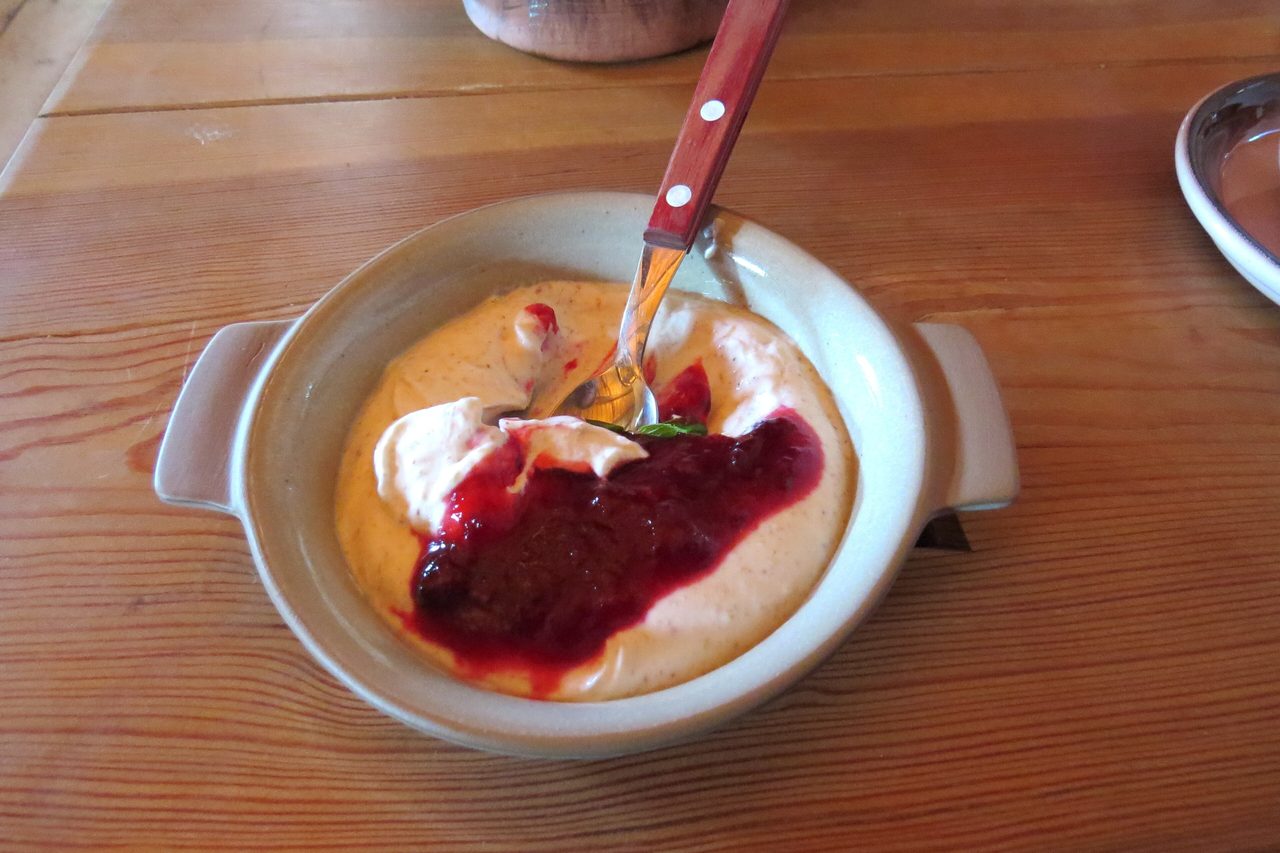
- double cream · whipped with 2 tbsp sugar. More common in Florida today, and what the photo shows250 ml
Steps
- ⏲ 10 min
Heat the oven to 175°C. Crush the crackers fine, mix with the butter and sugar, press firmly into the base and sides of a pie dish and bake 10 minutes. The baking is what lets the butter set as it cools so the crust stands up.
- ⏲ 3 min
Whisk the yolks with the lime zest for 3 minutes, until pale and increased in volume.
Stir in the condensed milk, then add the lime juice a little at a time, stirring. It thickens visibly as it goes in, and that is the acid, not heat — the acid coagulates the casein in the condensed milk and it sets on the spot. In principle this filling does not need the oven at all (dairy and heat).
- ⏲ 15 min
Bake it anyway. Pour it into the crust and give it 15 minutes at 175°C. The point is not thickness but bringing the yolks to a safe temperature and firming the surface. Take it out while the centre still wobbles slightly; baked until fully set, it cracks.
- ⏲ 5 min
Make the syrup for the meringue: boil the sugar and water, without stirring, to 118°C. With no thermometer, that is the soft-ball stage — a drop in cold water forms a soft ball (what sugar does).
- ⏲ 5 min
Whisk the whites with the salt to soft peaks. Keeping the whisk going, pour the boiling syrup down the side of the bowl in a thin stream. Carry on for about five minutes, until the bowl is only lukewarm. The hot syrup cooks the whites, which is why this meringue does not collapse the way a French one can.
Put the meringue on while the filling is still hot. This is the rule that stops it weeping: on a cold filling the contact surface never cooks, and liquid gathers there later.
Spread the meringue right out to the crust so it is completely sealed. Any gap is where the meringue shrinks away and slides off. Pull peaks up with the back of a spoon.
- ⏲ 6 min
Bake at 200°C for 6 minutes to colour the tips only; a blowtorch is more precise if you have one. Baked longer, golden droplets appear on the surface — that is sugar weeping out, and it means overcooked.
- ⏲ 180 min
Cool completely at room temperature, then chill at least 3 hours. It has to be cold for the filling to firm up and cut cleanly. Serve cold (serving temperature).
Tips & Variations
Variations
- The whipped cream version — which is what the photograph on this page shows: in Florida today whipped cream is more common than meringue, and the quantities are in the ingredient list. The traditional topping, and the one this page explains, is the meringue.
- Key limes and Persian limes: key limes are small, seedy, and ripen yellow, and they are more acidic and more aromatic than the common Persian lime. That said, bottled key lime juice is standard even in Florida — squeezing 150ml out of fruit that size takes more than twenty of them. It is not a shortcut that costs you authenticity.
- Why condensed milk: fresh milk did not reach the Florida Keys before refrigerated shipping. Tinned condensed milk was the dairy you could get on the islands, and it made this pie. A rare case of an ingredient being the history.
- Frozen key lime pie: the same filling, unbaked and frozen. Since it sets by acid in the first place, it holds its shape frozen too.
- Against cheesecake: both are a dairy filling in a crumb crust, set by different means. Cheesecake sets because egg coagulates with heat; this sets because acid coagulates at room temperature.
- Against panna cotta: set with gelatine. Three ways to set the same milk and sugar — gelatine, egg, acid.
- The same principle as ceviche: lime juice denaturing fish protein until it looks cooked and lime juice coagulating the protein in condensed milk are the same event. Acid does part of what heat does.
- Against rasgulla: there the point of acid-setting milk is to make curds you lift out as cheese; here the point is to leave the set alone. The difference is how much acid.
- Against the meringue in macaron: macarons use Italian meringue too, cooked and stabilised by hot syrup in the same way. Pavlova and Eton mess use French meringue and are far softer.
Tips
- The acid sets the filling, not the oven. You can watch it thicken as the juice goes in: the acid coagulates the casein in the condensed milk into a network. In principle it would set without any baking at all. The oven is there for the yolks.
- Add the juice gradually. Poured in at once, the acid acts too strongly in one spot and you get grains. Stir and trickle.
- There is no shame in bottled key lime juice. Key limes are small and full of seeds; 150ml takes twenty-odd fruit. Most Florida kitchens use the bottle.
- Do not confuse it with evaporated milk. This is made with sweetened condensed milk. Evaporated has neither the sugar nor the concentration and it will not set.
- Take it out while the centre wobbles. Baked until fully firm in the oven, it contracts as it cools and the surface cracks. The fridge finishes the job.
- The meringue goes onto hot filling. Meringue put on a cold filling is the most common reason this pie weeps: the contact surface has to cook, or liquid collects between the two.
- Seal it to the crust. Meringue shrinks a little as it bakes, and if the edges are not anchored to the crust it slides off in one piece.
- Golden beads mean overbaked. Those brown droplets on the surface are sugar weeping out of the meringue. Colour on the tips is enough, and a blowtorch makes it easier.
- Italian meringue is the safer one. Syrup at 118°C cooks the whites, so it is more stable than a French meringue made with half-raw white, and it has not collapsed by the next day.
- Chill it before cutting. At room temperature the filling is soft. Three hours is the minimum and overnight cuts cleanest. Dipping the knife in hot water and wiping it between cuts keeps the faces sharp.
The basics behind this dish
- Eggs: Coagulation Temperatures and What They DecideWhite sets at 62°C, yolk at 68°C. Those two numbers explain scrambled eggs, boiled eggs, steamed custard and crème anglaise all at once.
- Why Sauces Split: Emulsions and Pan SaucesA cream sauce breaking and a carbonara scrambling are the same failure. Temperature and emulsifiers — plus how to bring a split sauce back.
- Knife Skills: Grip, Cuts, and Why Size MattersHow you hold the knife matters more than how fast you cut. The pinch grip, the claw hand, and why uniform size is a cooking decision rather than a cosmetic one.
More of the same kind


More from this country


Sign in to edit.
AI-drafted, editor-reviewed · edits: 0 ·Edit history
https://cookiki.com/en/r/key-lime-pie · cookiki · User contributions are licensed under CC BY-SA 4.0.