
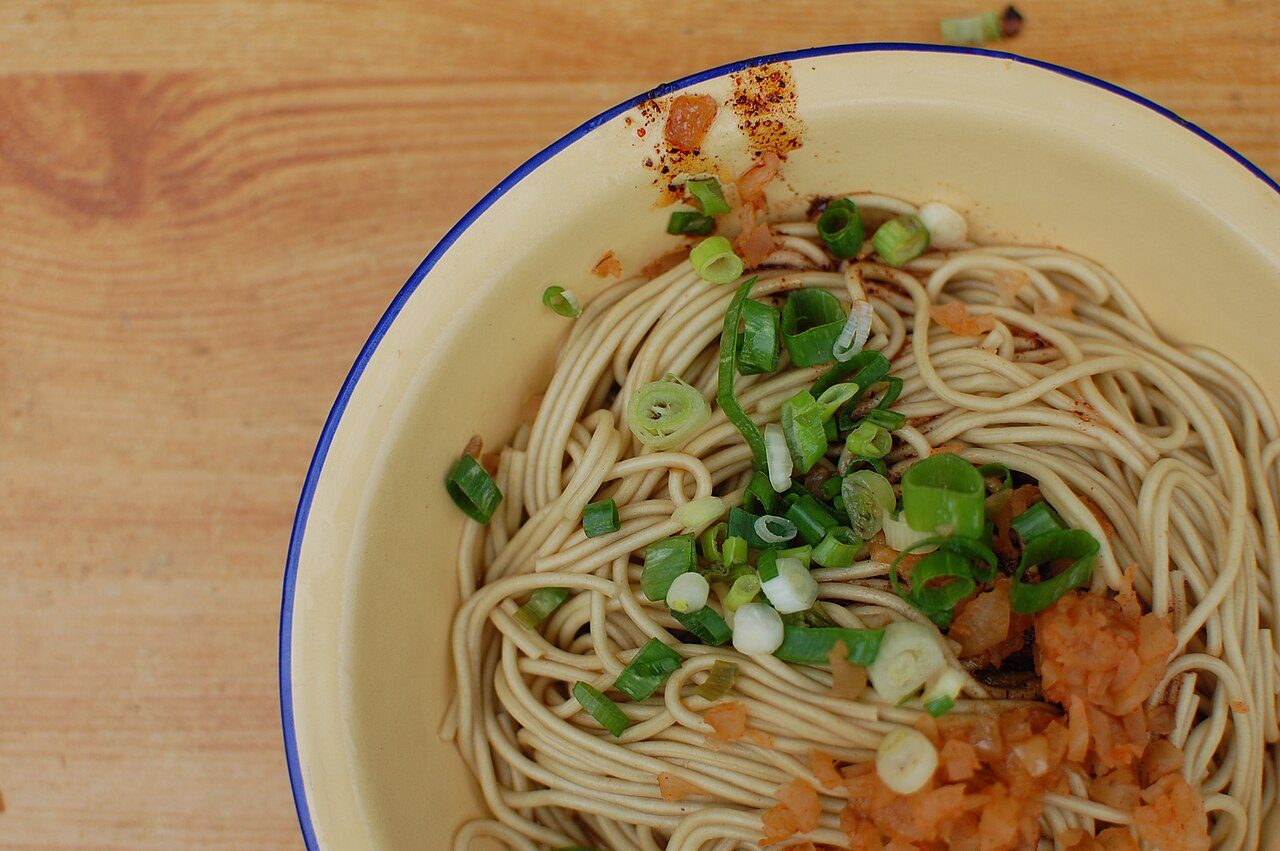
Photo: Liuxingy · CC BY-SA 4.0
Liangpi (Cold Wheat-Starch Noodles, and the Gluten That Came Out of Them)
The cold noodle of Xi'an, made by rinsing a wheat dough apart into starch and gluten and then eating both. This site's har gow page states flatly that without wheat starch you cannot make that dumpling, and explains wheat starch as "what remains after flour is washed to remove the gluten." Liangpi is the dish that does that washing at home, as step one — and it does not throw the gluten away. The settled starch water is steamed into translucent sheets and cut into noodles; the gluten left in your hand is steamed into a sponge called mianjin and piled on top of them. One dough, separated into its two components, both on the same plate.
Ingredients
- Washing the dough (serves 2)
- plain flour · bread flour gives a bigger gluten ball300 g
- water · for the dough150 ml
- salt3 g
- water for rinsing · cold, used in three changes1.5 L
- Dressing
- chilli oil · oil poured hot over chilli flakes with star anise and Sichuan pepper3 tbsp
- black vinegar · Chinkiang for preference2 tbsp
- soy sauce1 tbsp
- garlic water · 1 tbsp minced garlic steeped in 2 tbsp water for 10 minutes2 tbsp
- sugar1 tsp
- sesame oil1 tsp
- On top
- cucumber · julienned0.5
- bean sprouts · blanched100 g
- coriander · optional1 handful
- toasted white sesame1 tsp
Steps
- ⏲ 30 min
Mix the flour and salt with the water into a stiff dough, cover it, and let it rest 30 minutes. Up to here it is a kalguksu or mandu dough; the reason for the rest is in dough and gluten.
- ⏲ 15 min
Put 500ml of cold water in a big bowl, submerge the dough and work it with your hands. Within three or four minutes the water goes milky. That white is the starch. Pour the cloudy water off into a second large container and do the same thing twice more with fresh cold water.
- ⏲ 5 min
After three rinses what is left in your hand is one yellowish, rubbery lump. That is the gluten (mianjin), which is the flour with only its protein remaining. Do not throw it out — keep it under water in the fridge.
- ⏲ 240 min
Strain the collected starch water and leave it somewhere cool for at least 4 hours, overnight for preference. Starch granules are denser than water and do not dissolve in it, so they settle. Pour off the clear water on top. Gamja jeon and tangsuyuk both call the settled starch the secret and explain why; here it is not a secret inside another dish but step one.
- ⏲ 10 min
Stir the settled paste smooth and slacken it to about the consistency of thin cream. Add a little water if it is stiffer. Off a ladle it should fall in a thin unbroken stream.
- ⏲ 3 min
Oil a flat metal tray very lightly, pour in enough batter for a 2mm layer and tilt it level. Float the tray on boiling water, or set it in a steamer, cover, and steam 2-3 minutes. It is done when the whole surface has gone translucent and big bubbles lift.
- ⏲ 30 min
Cool the tray in cold water and peel the sheet off. Repeat until the batter is gone, and stir it again before every single pour — the starch is suspended rather than dissolved, and it settles back within a minute.
- ⏲ 20 min
Flatten the gluten lump with your hands and steam it 20 minutes. It puffs into a holey sponge; cool it and cut it into bite-size pieces.
- ⏲ 10 min
Stack the sheets and cut them into 1.5cm strips. Pile them with the cucumber, bean sprouts and the cut mianjin. Mix the dressing, pour it over at the last moment, scatter sesame and coriander, and toss well.
Tips & Variations
Variations
- Mianjin liangpi. That is the recipe above: the washed-out gluten steamed and served with the noodles, which is the commonest form in the Guanzhong plain of Shaanxi. The photograph shows the plain version, without mianjin — street stalls more often sell just the noodles. If you would rather not deal with the gluten, 200g of bought wheat starch slaked in 700ml of water gives the same sheets — it just removes half of the dish.
- Majiang liangpi. Dressed mainly with Chinese sesame paste rather than chilli oil, the same family of sauce as dan dan noodles. Shredded cucumber is not optional in this one.
- Hanzhong liangpi (Hanzhong mianpi). In the south-west of Shaanxi it is more often served hot rather than cold, seasoned with nothing but garlic and chilli oil.
- Gan mianpi. The Qishan version, made by repeating the washing far more thoroughly. Darker and considerably firmer.
- How it relates to har gow. That page says outright that without wheat starch you cannot make har gow. Liangpi is the dish that makes the wheat starch out of flour. But har gow then scalds that starch with boiling water into a dough and rolls it by hand, where liangpi slakes it into a liquid and steams it. Same material, different state.
- Against cheung fun. Both steam a thin sheet, but cheung fun pours a rice flour liquid straight from the bag while liangpi's liquid was taken out of a wheat dough. And cheung fun goes to the table hot; this one cold.
- The Qin Shi Huang story. The tale goes that a drought left Shaanxi unable to send its annual tribute of rice, so the villagers ground last year's old rice, let it settle and steamed it — and were praised for it. Which is why rice-flour liangpi also exists.
Tips
- Stir before every pour. Most failures with this dish are here. Unstirred, the first sheet is thin water that will not set and the last is thick paste that steams into a rice cake.
- Overnight beats four hours, noticeably. Under-settled, starch leaves with the water you pour off and the yield drops, and the paste that is left is too wet to judge.
- Do not go over 2mm. Thicker and it never turns fully translucent; the white patches taste raw.
- The tray has to be thin metal. A heavy one takes so long to heat that the starch settles in it while you wait.
- Flatten the gluten before steaming it. Left as a ball, the outside cooks and the middle stays raw dough.
- Steep the garlic in water rather than frying it. Raw garlic infused into water is the Shaanxi way, and it gives the kind of pungency that arrives up the nose.
- Never dress it ahead. Once the sheets take up black vinegar the colour goes muddy and they tear.
The basics behind this dish
- Choosing Flour: Protein Is the Whole StoryBread, plain and cake flour differ in one number: protein. What that number decides, how to fake one from another, and the things sold beside flour that are not flour at all.
- Cooking Noodles: Salt, Starch, and Whether to RinseWhy the water is salted, why oil in it is a mistake, and the actual rule for which noodles get rinsed and which never do.
- Dough and Gluten: When to Build It and When to Avoid ItThe same flour and water becomes a dumpling wrapper or a tender pancake. The difference is whether you built gluten or avoided it — and kneading and resting do different jobs.
More of the same kind


More from this country


Sign in to edit.
AI-drafted, editor-reviewed · edits: 0 ·Edit history
https://cookiki.com/en/r/liangpi · cookiki · User contributions are licensed under CC BY-SA 4.0.