
Yōkan (Agar-Set Red Bean Confection)
The Japanese confection of sweet bean paste set with sugar and agar, firm enough to cut with a knife. This site had three setting agents — gelatine in panna cotta, collagen in pyeonyuk, starch in dotori-muk. Agar is a fourth, and it behaves as the opposite of gelatine. It sets at around 40C and does not melt until past 85C, so a piece holds its shape in your hand and does not melt in the mouth. Gelatine must never be boiled; agar must be boiled. That is the other way round too.
Ingredients
- The bean paste
- azuki beans · dried; or 600g of ready-made smooth koshi-an300 g
- water · for boiling, changed and discarded twice2 L
- To set it
- sugar · do not cut it because it looks like a lot — here the sugar is the preservative350 g
- powdered agar · or 15g of agar strands; it has to be boiled8 g
- water · to dissolve the agar300 ml
- salt1 pinch
- glucose syrup · optional; it slows the surface drying out30 g
- The mould
- square tin · about 15x15cm, wetted with water so it turns out cleanly1
Steps
- ⏲ 20 min
Rinse the beans, cover with water and bring to the boil. Throw that water away, cover again and repeat. Do this twice — the harsh saponins leave with the water. That pulses are on the "discard" side of Soaking is the reason.
- ⏲ 55 min
Add fresh water and simmer 50-60 minutes, until a bean crushes under a finger. Top up with hot water as it reduces; cold water toughens the skins.
- ⏲ 15 min
Push the beans through a sieve to leave the skins behind (koshi-an). Skip this and you have the coarse version (tsubu-an).
- ⏲ 5 min
Whisk the powdered agar into 300ml of water and bring it to the boil. If you do not boil it, it will not set. That is the exact reverse of gelatine, so do not forget it. Give it two minutes at a boil.
- ⏲ 25 min
Dissolve the sugar into it completely. Add the bean paste and salt and cook it down, stirring with a wooden spoon, until a line drawn with the spoon holds for a moment.
- ⏲ 3 min
Off the heat, stir in the glucose syrup. Pour it into the mould at once, while hot — agar starts setting at about 40C, so there is no time to let it cool on the way. Level the top.
- ⏲ 120 min
Leave it two hours at room temperature. It does not need the fridge to set. Chill it in a hurry and the surface sets first and cracks.
- ⏲ 10 min
Turn it out and cut it with a wet knife. Faces as flat as the blade mean it set properly. Wrap the pieces individually in paper or film.
Tips & Variations
Variations
- Mizu-yōkan. More water and less agar, set much softer. Eaten cold in summer, and it keeps far less well. The recipe above is the firm one, neri-yōkan.
- Imo-yōkan. Sweet potato instead of azuki. Chestnut, matcha and white bean versions work the same way.
- Coarse paste. Skip the sieving and the skins stay in, which gives it texture.
- Mushi-yōkan. The older method: flour or kudzu instead of agar, steamed to set. Much chewier.
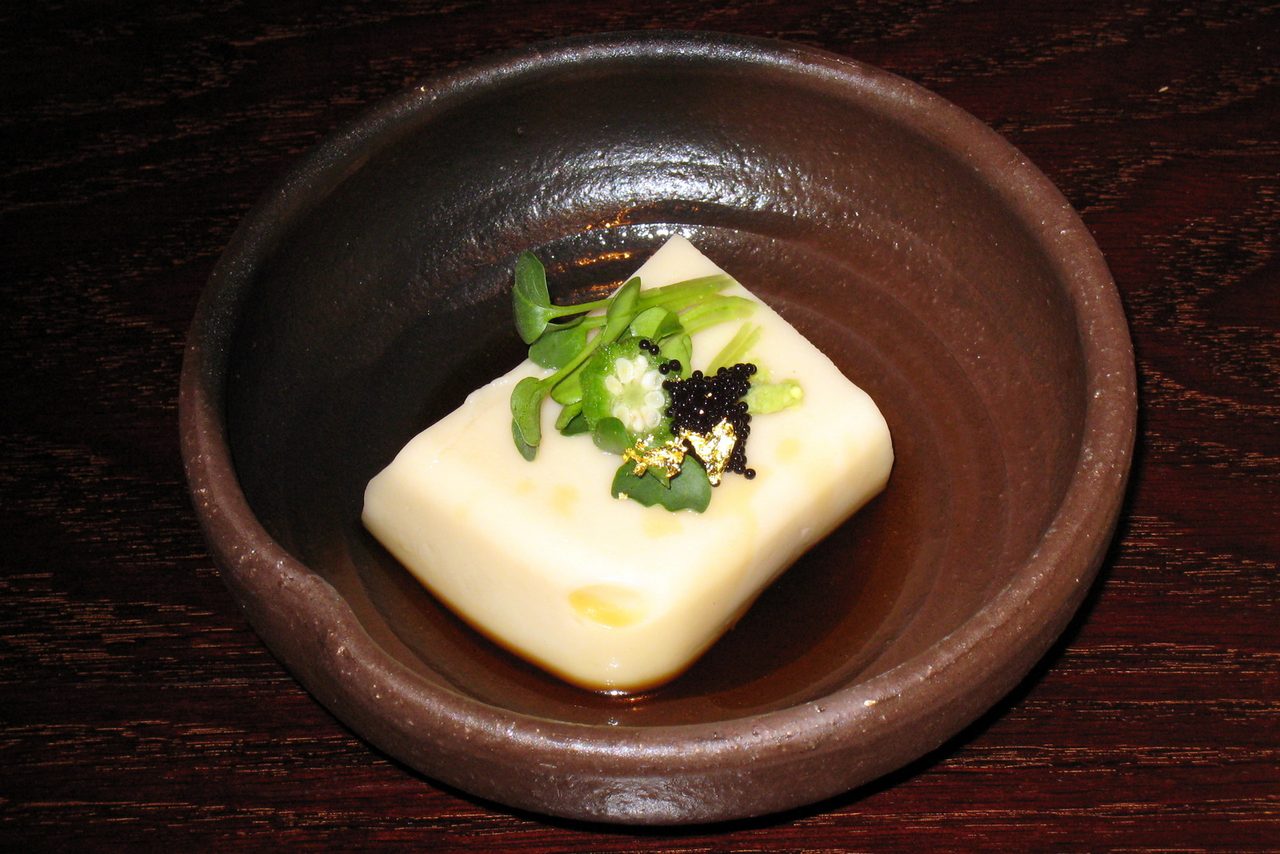
- About the photograph. The object partly visible at the left of the hero is not yōkan but a kuzu-manjū — that is what the original Commons description says. The crop leaves only the yōkan block.
Tips
- Agar is this site's fourth setting agent. Panna Cotta uses gelatine, Pyeonyuk uses the gelatine that came out of collagen, and Dotori-muk uses starch. Agar is a polysaccharide from red seaweed, and its temperature behaviour is nothing like any of the three. The dish that does the extracting is tokoroten — and powdered agar was found by freezing and thawing tokoroten over winter nights.
- Two ways it is the reverse of gelatine. Gelatine loses its setting power if boiled, sets at about 15C and melts at body temperature. Agar has to be boiled to dissolve, sets at around 40C, and does not melt again until past 85C. So panna cotta disappears in the mouth and yōkan is chewed. It is also why a piece holds its shape in your hand in summer.
- The sugar is preservation, not sweetness. What Sugar Does gives sugar four jobs — sweetness, colour and aroma, moisture retention, structure. Preservation is not on that list. Yōkan is the dish that stands on the fifth one: the sugar concentration leaves almost no free water for microbes, and it keeps over a year at room temperature. That is why it is sold in Japan as emergency rations.
- Which means cutting the sugar makes a different thing. It is not simply less sweet — the keeping goes, and so does part of the set. If you do reduce it, plan on the fridge and a few days.
- Compared with Dotori-muk. A starch gel is opaque and weeps water after a few days as the starch retrogrades. An agar gel is clear and does far less of that. Oyster Omelette is the same starch gel deliberately left half set, which puts four points on one axis.
- Pour it hot. It begins setting at 40C, so if it cools in the pan you are already too late. Wetting the mould first is what lets it turn out.
- Cut it with a wet knife. A dry blade drags at the surface and the faces come out ragged.
The basics behind this dish
- Freezing and Thawing Without Wrecking the TextureTexture damage from freezing comes down to ice crystal size. Freeze fast, exclude air, thaw in the fridge, and most of the problem disappears.
- What Sugar Does Besides SweetenCutting the sugar does not just cut sweetness. Colour, moisture, structure, and the counterweight to salt and acid — which is why savoury dishes call for it too.
- Serving Temperature: Why Some Dishes Wait and Some CannotWhy cold dishes need heavier seasoning, why rice and rice cake go stale fastest in the fridge of all places, and the dishes where letting the steam off is the point.
More of the same kind


More from this country


Sign in to edit.
AI-drafted, editor-reviewed · edits: 0 ·Edit history
https://cookiki.com/en/r/yokan · cookiki · User contributions are licensed under CC BY-SA 4.0.