
Photo: Ptyx · CC BY-SA 4.0
Kokoretsi (Offal Wrapped in Caul and Wound with Intestine)
Lamb or goat offal — liver, heart, lung, sweetbread — threaded onto a spit, wrapped in a sheet of caul fat and then wound tightly all over with the small intestine, and turned over charcoal for hours. Offal of this kind carries almost no fat of its own, and where other fires deal with that by keeping fat away, this one wraps the leanest thing on the animal in nothing but fat. What stops it dripping is the turning: the fat renders, travels round the surface instead of falling, and the intestine on the outside tightens over it.
Ingredients
- Lamb small intestine · order ahead from a butcher; about 2cm across2 m
- Lamb caul fat · about 400g; order it with the intestine1 sheet
- Lamb liver300 g
- Lamb heart · valves and sinew trimmed out400 g
- Lamb lung · hard to buy in some countries — use more heart300 g
- Lamb sweetbreads · optional200 g
- Cleaning the intestine
- Flour4 tbsp
- Coarse salt3 tbsp
- Vinegar100 ml
- Lemons2
- Basting and seasoning
- Olive oil60 ml
- Lemon juice60 ml
- Dried oregano2 tbsp
- Salt2 tsp
- Coarsely ground pepper2 tsp
Steps
- ⏲ 15 min
Turn the intestine inside out. Fold one end back over itself and run water into the fold — the weight of the water rolls it through on its own. Trying to push it through by hand tears it.
- ⏲ 30 min
Scrub the turned intestine with flour and coarse salt on both faces. The flour binds to the mucus and comes away with it. Then soak it 30 minutes in water with the vinegar and half a lemon squeezed in.
- ⏲ 10 min
Rinse under running water and smell it. If anything is still there, repeat with salt and lemon. Nothing later in the recipe fixes a casing cleaned carelessly.
- ⏲ 30 min
Trim the offal: split the heart and cut out the valves and white sinew, peel the membrane off the liver, cut the thick airways out of the lung. Cut everything into 3-4cm pieces.
- ⏲ 15 min
Toss the pieces with salt, pepper and oregano and thread them onto a flat metal spit. Spread the liver out among the heart and lung rather than grouping it.
- ⏲ 10 min
Spread out the caul fat and wrap the whole threaded length in a single layer. Two or three layers will not all render, and what is left inside stays slippery.
- ⏲ 20 min
Tie one end of the intestine to the spit and wind it along the parcel, overlapping with no gaps, then tie off the far end. This winding is what holds the whole thing together as it cooks.
- ⏲ 30 min
Let the charcoal burn down until the coals have greyed over, then set the spit about two hand-spans above them. Turn it especially slowly for the first half hour.
- ⏲ 120 min
Turn it for 90 minutes to two and a half hours, basting every half hour with the olive oil, lemon juice and oregano mixed together. It is done when the intestine outside has tightened to a deep brown and feels firm.
- ⏲ 15 min
Rest it on the spit for 15 minutes. Slide it off and either cut it into 2cm rounds or chop it coarsely on a board. Serve with more oregano and lemon, and bread.
Tips & Variations
Variations
- Kokoreç: the Turkish name and the Turkish form. Same construction, different last five minutes — the cooked length is chopped fine on a griddle with chilli, oregano and cumin, then packed into a split loaf with tomato. Greece roasts it whole, slices it and puts it on a plate; Türkiye chops it and makes a sandwich of it.
- Splachna: at Easter it goes over the coals alongside the whole roast lamb, paired with mageiritsa, the offal soup eaten the same night — one boiled, one grilled, from the same animal.
- How much liver: some shops push it to half the weight. It is cheaper and it turns chalky. See the Tips.
- On an oven rotisserie: on a domestic rotisserie rod at 180°C for two hours. The surface never dries the way it does over coals, so it stays a little softer, and there is no smoke. With no rod, turn it by hand every half hour — but read the Tips first, because here the turning is a piece of equipment and not a convenience.
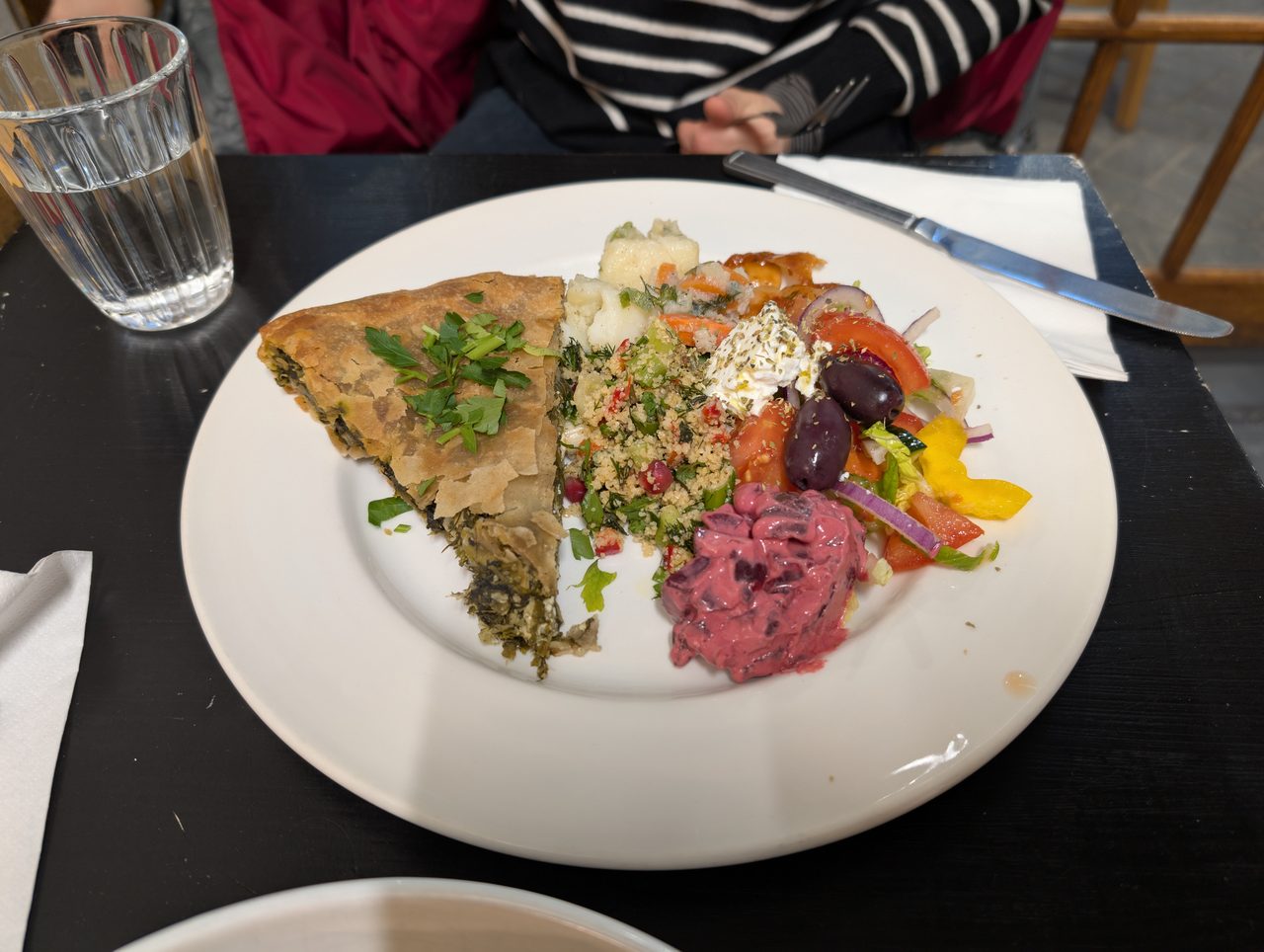
- What goes with it: chips, pita, tomato and onion. That is the plate in the photograph.
- Against sundae and haggis: three dishes that put offal into a casing, and the casing sits in a different place in each. Sundae fills an intestine and you eat the intestine. Haggis fills a stomach and you throw the stomach away. Kokoretsi winds an intestine round the outside, and you eat that.
- Against anticuchos: the same offal over the same charcoal, with a cooking time thirty times longer. The first Tip is why.
Tips
- The caul fat is not packaging, it is the dish's fat supply. The starting point is what anticuchos writes about the same family of offal: "What it has almost none of is fat, which makes the window extremely narrow — two minutes a side, and past that it is leather" Liver, heart, lung and sweetbread all carry almost no intramuscular fat, so if it is not brought in, there is none. That page answers by finishing in two minutes. This one answers by putting a whole sheet of fat over the outside and going for two hours. The caul renders steadily from inside the wrapper, and when it has gone there is nothing left of it — what reaches the plate is the offal it basted and the intestine that caught it.
- Why a dish that puts fat on a fire does not flare. Grilling says of flames raised by dripping fat that they "deposit soot — carbon from incomplete combustion — onto the surface of the meat", and gives two ways to stop it happening at all — take the fat out of the ingredient, as suya does ("Roasted peanut is about half fat, so ground onto meat over a fire it melts and runs — and what runs down is exactly the flare-up above"), or else "Fatty cuts should start on the cool side in the first place". Kokoretsi does neither. It gives the fat no time to fall. The spit never stops, so rendered fat is dragged sideways before it can head down, and within one rotation the intestine on the outside has taken it and spread it back over the surface. Turning it by hand now and then will not do this; between turns, the fat drips.
- The turning is equipment, not convenience. The same guide lists a skewer's jobs as forcing uniform size and this: "It lets you turn everything at once" Here the turning is not an action but a state. Asado sits at the opposite end — strapped to an iron cross, stood well back from the coals, and not turned at all. Two answers to dripping fat: move the food away from the fire, or never let it stop moving.
- Winding the intestine round the outside is structure, not decoration. Heat shrinks it, and it tightens over everything inside. That contraction is why nothing falls off the spit once the caul has rendered and the offal has softened — which is also why the winding must overlap with no gaps. A gap is a place that opens later (wrapping and sealing).
- Where the casing sits is what this dish is. Haggis is blunt about its own — "The casing is a vessel, not a food" — and sundae's intestine is part of what you eat. In both, the casing contains. Here it covers: it is eaten, and it is also the browned surface. Half of what this tastes of is that tightened brown skin.
- Cleaning the casing is half the work, exactly as sundae puts it: "Cleaning the casing is half the work" Lamb intestine is stronger-smelling than pig, so vinegar and lemon get a round of their own. Do not skip turning it inside out — the inside is the worse half.
- Keep the liver under a quarter. Haggis caps it at a fifth for the same reason: "Liver is strong and turns chalky with long heat" Two hours over fire makes that worse, not better. Heart should be the spine of it, with the liver spread through.
- Wait for the coals to grey over. Caul fat over coals that are still flaming does not brown, it takes on the soot of an incomplete fire. Ash on the surface is the starting line (grilling).
- Judge it by feel, not the clock. Thickness moves the time by up to an hour. When the intestine has tightened to a deep brown and feels firm under a finger, the inside is long done — the offal gets there well before the surface does.
- Do not reheat it over fire. A second heat toughens offal. Cold kokoretsi is better chopped small into bread, or eaten as it is with lemon (reviving leftovers).
The basics behind this dish
- Deep Frying: Temperature, Batter, and the Second FryFrying is not cooking in oil so much as trading the food's water for it. Two temperatures, what each kind of coating is for, and why the second fry exists.
- Heat Control: Preheating, Oil, and Reading the PanThe same ingredients become a different dish depending on pan temperature. When to add the oil, how to read heat by sound, and which dishes want low heat instead.
- Knife Skills: Grip, Cuts, and Why Size MattersHow you hold the knife matters more than how fast you cut. The pinch grip, the claw hand, and why uniform size is a cooking decision rather than a cosmetic one.
More of the same kind


More from this country


Sign in to edit.
AI-drafted, editor-reviewed · edits: 0 ·Edit history
https://cookiki.com/en/r/kokoretsi · cookiki · User contributions are licensed under CC BY-SA 4.0.