
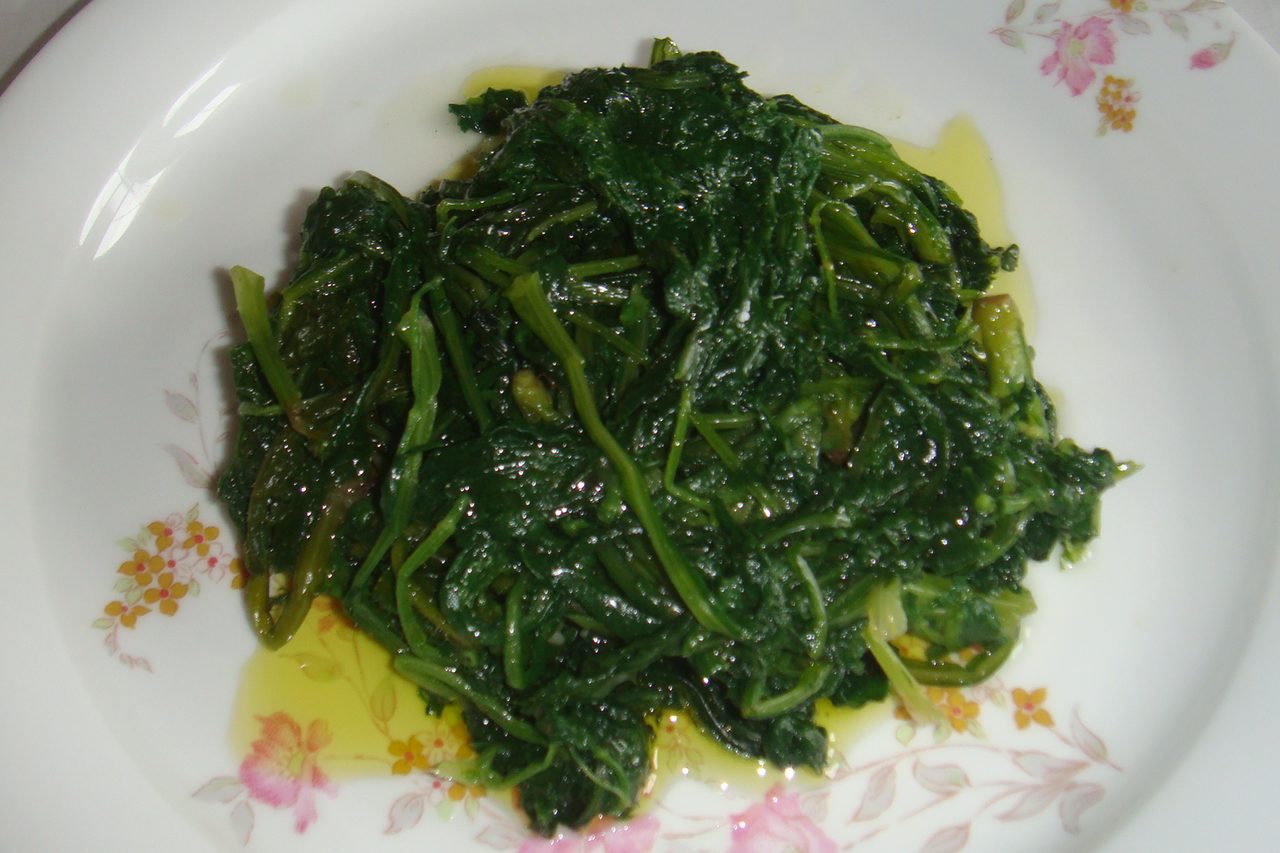
Photo: El Mono Español · CC BY-SA 4.0
Spanakorizo (Spinach and Rice Cooked in the Spinach Water)
A Greek rice dish in which the spinach is wilted first and its own liquid cooks the rice. Dill goes in by the handful, the olive oil is not rationed, and the lemon is squeezed over after the heat is off. The liquid is not poured in and measured; it comes out of the vegetable, so the rice goes in after you can see how much there is. Eaten warm or at room temperature, with feta alongside.
Ingredients
- Spinach · trimmed and washed; or 500g frozen1 kg
- Medium-grain rice · rinsed and drained; Greek cooks use Carolina rice200 g
- Onion · finely chopped1
- Spring onions4
- Olive oil · do not cut this back — it is a ladera dish100 ml
- Dill · stalks and all, chopped1 large bunch
- Lemon1
- Salt1 tsp
- Black pepperto taste
- Hot water · only what the spinach has not already givenas needed
- To serve
- Feta150 g
Steps
- ⏲ 8 min
Wash the spinach and shred it coarsely. Shake it, do not wring it. The water still clinging to the leaves is part of the liquid this dish cooks in.
- ⏲ 8 min
Soften the onion and spring onions in the olive oil for 8 minutes without colouring them. This is a pale dish and browning muddies it.
- ⏲ 7 min
Add the spinach a handful at a time, waiting for each to collapse before the next. The volume falls away and liquid starts to gather in the base.
- ⏲ 2 min
Cook 2 minutes more once it is all in, then look at the pan. This is the measuring step — what has gathered there is this dish’s cooking liquid.
- ⏲ 2 min
Stir in the rice, then add hot water only until the liquid stands at about twice the volume of the rice. Season with salt and pepper.
- ⏲ 18 min
Cover and cook on the lowest heat for 15-18 minutes without stirring. Add a splash of hot water if it dries before the rice is soft.
- ⏲ 1 min
Off the heat, stir through the dill and the lemon juice. The lemon goes in here and not before.
- ⏲ 10 min
Leave it covered 10 minutes. The rice takes up what liquid is left.
Crumble the feta over, add a last pour of olive oil, and serve warm or at room temperature.
Tips & Variations
Variations
- Prasorizo: leeks instead of spinach. Leeks give up far less liquid, so more hot water goes in and this dish's particular trick applies much less.
- With tomato: in the Peloponnese a grated tomato goes in and turns it red. Tomato brings water of its own, so pour in less.
- Bulgur or trahana instead of rice: bulgur cooks faster, so the spinach goes in later.
- Eaten cold: many Greek cooks rate it better the next day at room temperature. Chilled, the olive oil stiffens and dulls it, so give it a fresh pour before serving.
- Same leaf as horta, a different aim: horta boils tough wild greens for twenty minutes to talk their bitterness down; this barely wilts tender spinach. Only the oil and the lemon are shared.
Tips
- The ratios in cooking rice are all ratios of a liquid you pour in. That guide gathers the dishes that cook rice in something other than water — coconut milk, stock, the water lentils were boiled in — because "a cup of the liquid is not a cup of water." It puts it as "several dishes here cook rice in something that is not water — where three quantities change at once, not one." Every one of those, though, is measured before it goes in the pot. Spanakorizo breaks that premise: the liquid comes out of the spinach, and how much depends on the spinach. So the order reverses — wilt first, look at what has gathered, then add the rice. The only number a recipe can honestly give is the final level, not the pour.
- One other dish breaks the same premise, and what follows differs. Lo bak go adds no water either — "Cooked covered, that water comes out and pools in the pan, and it is what hydrates the flour — so the ratio cannot be measured from a jug." That much is shared. What differs is the job the liquid has. There the water hydrates a flour batter that then sets, so too little only makes it stiff and you can judge it by eye as you mix. Here the water is an amount a grain has to absorb, and too little leaves a chalky core you cannot go back and fix. So that dish adds its flour last, and this one tops the level up with hot water first.
- A kilo of spinach is not a misprint. A leaf vegetable is mostly water and its volume is mostly air. Wilted, it comes down to a couple of handfuls, and the volume that disappeared is sitting in the bottom of the pan. It is supposed to look absurd going in.
- Not wringing it out is a different reason again from horta's. Horta does not squeeze because "Hot leaves absorb oil; cooled ones only carry it on the surface.", while sigeumchi namul must be wrung out, since "it uses very little sesame oil, so leftover water makes the seasoning slide off." Spanakopita squeezes hardest of all — "Squeeze the spinach really dry so the pie doesn't turn soggy." All three decide by what the leftover water would spoil.** Here it spoils nothing, because it is the cooking liquid.
- Give up on green here too. Fifteen minutes under a lid takes the colour to olive, exactly as blanching describes. It is horta's calculation again — "Horta that arrives bright green is undercooked." Holding the spinach back to keep it bright would mean not having its liquid to cook the rice in, so it is colour or method, and this dish picked method.
- The lemon goes in off the heat. Acid slows starch taking up water, and rice cooked in it keeps a chalky core however long you wait. Added at the end there is no such problem. The dill goes in at the same moment for a different reason: it is on the delicate side of fresh herbs, and long cooking takes its aroma out.
- Do not stir it. Stirring frees the surface starch and pulls it towards risotto. What this wants is not creaminess but grains that stay grains while becoming one body with the spinach.
- Cutting the olive oil makes it a different dish. Ladera means "the ones in oil": the oil is standing in for meat that is not there. By the division cooking oils draws, the oil here is not a cooking medium but the substance of the thing.
The basics behind this dish
- Blanching: Keeping Vegetables GreenBlanched vegetables go dull because of acid and heat. Why the pot should be large, why the lid stays off, and what the ice bath is really for.
- Salt: When You Add It Matters More Than How MuchThe same amount of salt either draws water out or seasons all the way through, depending on when it goes in. Osmosis, seasoning in layers, and why salt types are not interchangeable by volume.
- Knife Skills: Grip, Cuts, and Why Size MattersHow you hold the knife matters more than how fast you cut. The pinch grip, the claw hand, and why uniform size is a cooking decision rather than a cosmetic one.
More of the same kind


More from this country


Sign in to edit.
AI-drafted, editor-reviewed · edits: 0 ·Edit history
https://cookiki.com/en/r/spanakorizo · cookiki · User contributions are licensed under CC BY-SA 4.0.