
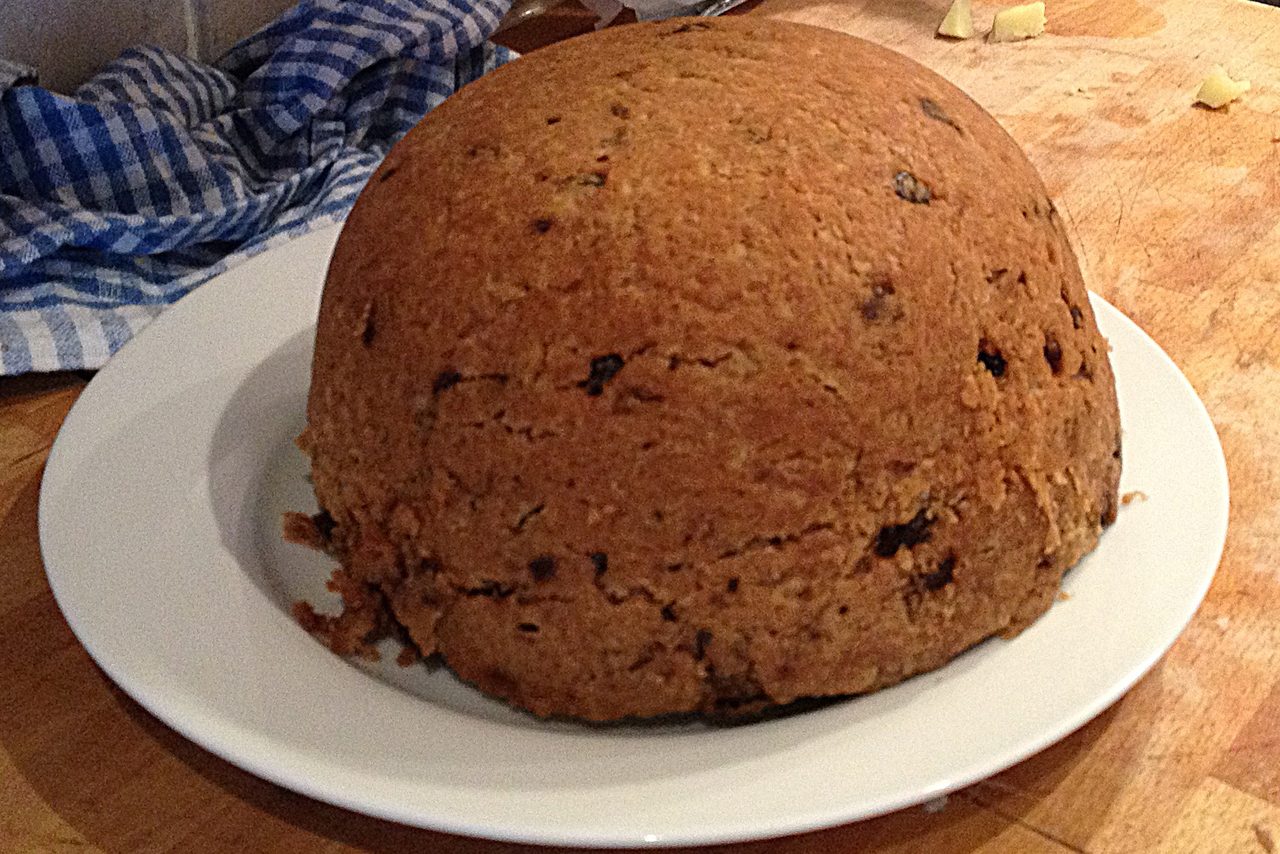
Photo: Douglas Paul Perkins · CC BY 3.0
Pound Cake
The English cake named after its formula: a pound each of butter, sugar, eggs and flour, all the same weight. Four ingredients and no raising agent, so the only thing lifting it is air beaten into the butter and sugar. That process, creaming, is the whole of this batter, and a pound cake that fails has almost always failed there before it ever reaches the oven.
Ingredients
- Batter (one 23x13cm loaf tin)
- unsalted butter · at room temperature; a finger should press in without it feeling greasy225 g
- sugar · the coarser the crystal, the more air it cuts225 g
- eggs · about 225g, and they must be at room temperature4
- plain cake flour · sifted twice225 g
- salt0.5 tsp
- vanilla extract · optional1 tsp
- Optional — the modern formula
- baking powder · not in the original; it makes failure far less likely1 tsp
- milk · to loosen the batter if it is stiff2 tbsp
- lemon zest · grated; it keeps the butter from cloying1 lemon
- For the tin
- butter · for greasing10 g
- flour · for dusting1 tbsp
Steps
Take the butter and eggs out well ahead and let them come to room temperature. This is half the recipe — cold butter will not hold air, and cold eggs re-solidify butter you have just creamed and split the batter. Butter at 18-20°C, holding a fingerprint without looking oily, is what you want.
Butter the tin thinly, dust it with flour and knock out the excess. Heat the oven to 170°C. This is a low, long bake, and in an oven that has not come up the batter sinks before the outside has set.
- ⏲ 8 min
Beat the butter and sugar together on medium speed for 8 minutes. It should turn pale cream and grow visibly in volume, and you should scrape the sides down a couple of times. Cut this short and the cake is shorter to match — this is the only thing raising it.
Add the eggs one at a time. Let each one disappear completely before the next goes in. Poured in together they break the emulsion, the batter curdles into something like cottage cheese, and the air you just beat in escapes. If it starts to split, add a spoonful of the flour to catch it.
Fold in the sifted flour and salt (and the baking powder if using) in two or three goes, with a spatula. Do not put the mixer back on. Gluten developed here gives you a tough bread, not a cake. Stop the moment no dry flour is showing.
Scrape the batter into the tin, level it, then draw a shallow trench down the centre with the spatula. That gathers the split where you want it, and gives the straight central crack a pound cake is supposed to have. Drop the tin twice on the worktop to knock out large bubbles.
- ⏲ 60 min
Bake at 170°C for 60 minutes. Once the top has taken enough colour, around the 30-minute mark, cover it loosely with foil. It is done when a skewer in the centre comes out without wet batter. Do not open the door in the first half hour.
- ⏲ 10 min
Cool in the tin 10 minutes, then turn it out onto a rack and cool completely. Cut warm, the crumb tears. A pound cake is at its best wrapped once cold and left a day.
Tips & Variations
Variations
- An actual pound of each: 450g of all four, as the name says, makes twice this cake. Household recipes came down to 225g because that is what fits one loaf tin, not because the ratio changed. Holding the ratio and scaling freely is the point of the formula.
- Madeira cake: the English version with lemon zest and a strip of candied citron laid on top. It is named for the wine it was served with; there is no wine in the cake.
- Quatre-quarts: the French name, meaning "four quarters" — a quarter each of the four ingredients, so the same cake. In Brittany it is made with salted butter.
- Bundt cake: in the United States this batter is enriched with sour cream or cream cheese and baked in a patterned bundt tin. It bakes longer, so drop the oven about 10°C.
- Flavouring it: lemon zest, Earl Grey leaves, matcha, rum-soaked dried fruit and ground almonds are all common. Take dry additions out of the flour weight, and toss wet ones (dried fruit) in a little flour first or they sink to the bottom.
- How it differs from banana bread: the same loaf shape, the opposite method. Banana bread is the muffin method — melted butter, minimal mixing — and it rises on bicarbonate of soda. A pound cake beats air into solid butter and rises on that air alone.
- Other things built by creaming: it is the first step of chocolate chip cookies, and of the batters in Sachertorte, babka and the biscuit shell of soboro-ppang. Scones do the reverse and keep the butter cold, and brownies melt the butter outright — which is why that crumb never opens.
- What to eat it with: strawberries and cream, or griddled and served with ice cream. In England it is simply sliced alongside tea, and it can stand in for the meringue in Eton mess.
Tips
- Judge creaming by what it looks like, not by the clock. Eight minutes is a guide; the end is when the mixture has lost its butter-yellow for a pale cream and grown visibly. It is a physical process — sugar crystals scraping the butter and cutting air pockets into it — so under-creamed means exactly that many fewer pockets and a shorter cake.
- Which is why coarse sugar beats fine. Icing sugar has no crystals left to do the scraping. For this batter, granulated sugar is a tool (what sugar does).
- Butter outside 18-20°C nearly always fails. Cold, it will not take air; starting to melt, it lets go of the air it had. Softening it in the microwave is the worst of both (butter).
- Eggs one at a time, fully absorbed. Adding egg to creamed butter is emulsifying water into fat. All at once is more than it can take, it curdles, and a curdled batter has lost its air (emulsions and pan sauces, cooking eggs).
- If it does split, a spoonful of flour brings it back. The starch takes up the loose water. Far better than pressing on regardless.
- Flour goes in with a spatula only. Gluten makes the crumb tough and gives you a cake that domes and then sinks in the middle. Use a low-protein cake flour and sift it twice so there is nothing to have to beat out (choosing flour, dough and gluten, flour).
- The crack down the back is not a fault. The crust sets while the inside is still rising and pushes through it. Draw a trench down the middle beforehand and the split gathers there, straight.
- Low oven, long bake. At 190°C the outside burns while the middle is still raw and then falls. 170°C for an hour is the benchmark; drop to 160°C in a fierce oven (what your oven is doing).
- Do not open the door in the first thirty minutes. Cold air on a structure that has not set yet drops it. Look at it after the half hour, and cover it with foil then.
- The original has no baking powder. The eighteenth-century cake rose on creaming alone, which is why it is dense and close-grained. The teaspoon in modern recipes is insurance against the creaming going wrong. Neither is correct: with it the cake is lighter, without it it is the original thing.
- A thermometer beats a skewer. 96-98°C in the centre means done. A skewer pushed into the crack can miss an underdone seam, so aim for the thickest part of the middle.
- Leave it a day. Wrapped once completely cold, the butter re-sets and moisture evens out through the crumb. It is better on the second day than fresh, keeps three or four days at room temperature, and freezes for a month (freezing and thawing, reviving leftovers).
- Never serve it cold. Butter that is set solid will not melt on the tongue and half the flavour goes with it. Out of the fridge, give it thirty minutes (serving temperature).
The basics behind this dish
- Eggs: Coagulation Temperatures and What They DecideWhite sets at 62°C, yolk at 68°C. Those two numbers explain scrambled eggs, boiled eggs, steamed custard and crème anglaise all at once.
- What Your Oven Is Actually DoingThe dial and the air rarely agree. Why preheating takes twenty minutes rather than five, why convection means lowering the number, and what an air fryer actually is.
- Why Sauces Split: Emulsions and Pan SaucesA cream sauce breaking and a carbonara scrambling are the same failure. Temperature and emulsifiers — plus how to bring a split sauce back.
More of the same kind



More from this country



Sign in to edit.
AI-drafted, editor-reviewed · edits: 0 ·Edit history
https://cookiki.com/en/r/pound-cake · cookiki · User contributions are licensed under CC BY-SA 4.0.