
Photo: Dr. Bernd Gross · CC BY-SA 3.0 de
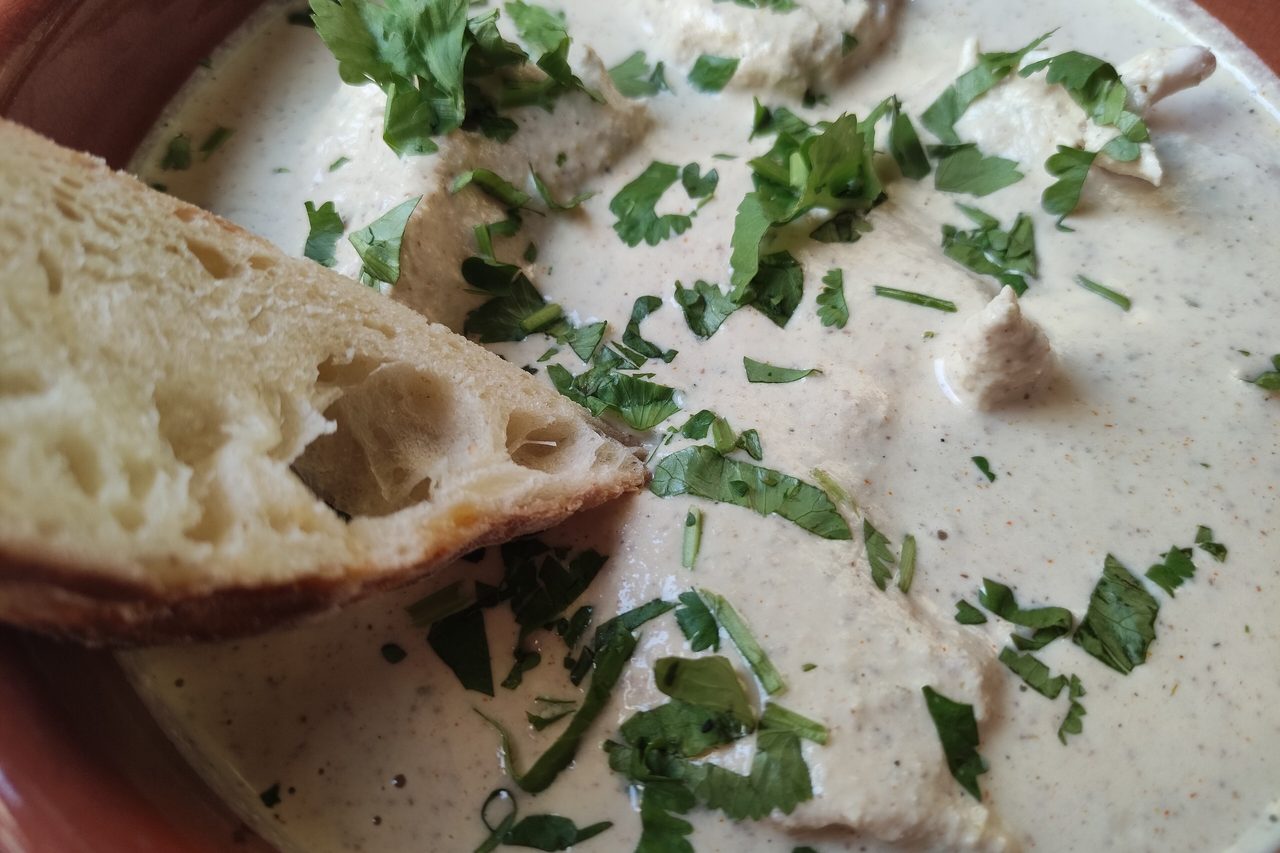
Blanquette de Veau (Veal in White Sauce)
One of the French national dishes: veal simmered white, and its own cooking liquid turned into the sauce. It breaks the first two rules of braising at once — nothing is browned, and the meat is fully submerged — for a single reason: here the cooking liquid is not a by-product, it is the sauce. It finishes with a liaison of egg yolks and cream, after which the pan can never boil again. Past about 82°C you no longer have a sauce, you have scrambled egg.
Ingredients
- Meat and cooking liquid (serves 4)
- veal shoulder or neck · cut into 4cm cubes; a cut with sinew in it is the right one1 kg
- water · enough to submerge the meat1.5 L
- carrots · one left whole for the liquid, one cut into 3cm lengths2
- onion · studded with 2 cloves1
- leek, white part1
- celery1 stick
- bouquet garni · thyme, bay and parsley stalks, tied1
- salt1 tsp
- Garniture
- button mushrooms · small ones whole, large ones halved250 g
- pearl onions · or shallots16
- butter20 g
- lemon juice · keeps the mushrooms pale1 tbsp
- Sauce (blond roux)
- butter50 g
- plain flour50 g
- Liaison (to finish)
- egg yolks2
- double cream150 ml
- lemon juice1 tbsp
- white pepper · black pepper leaves specks in a white sauce0.5 tsp
- parsley · chopped2 tbsp
- To serve
- steamed rice · or a pilaf, or boiled potatoes4 portions
Steps
- ⏲ 15 min
Do not brown the meat. There is no searing step in this dish at all. Put the veal in a pot, cover with cold water, bring it just up to the boil, then throw the water away and rinse the meat under cold water to wash off the grey scum. Discarding that first liquid is the condition for a white sauce.
- ⏲ 5 min
Return the rinsed meat to the pot and cover it completely with 1.5L of cold water. Add the whole carrot, the clove-studded onion, the leek, celery, bouquet garni and salt.
- ⏲ 90 min
Bring it to a bare simmer and hold it there 90 minutes, never letting it boil. The surface should barely tremble. Boiled, the fat emulsifies into the liquid and the sauce will never be white, and the fibres tighten as well.
- ⏲ 13 min
Meanwhile cook the garniture separately. Roll the pearl onions in butter without colouring them for 8 minutes, then add the mushrooms and lemon juice for 5 more. Simmered for 90 minutes with the meat, the mushrooms would disappear and the onions would collapse.
- ⏲ 15 min
When a fork meets no resistance, lift the meat out and strain the liquid, keeping 1 litre. Discard the vegetables. Simmer the cut carrot in that liquid for 10 minutes and lift it out.
- ⏲ 3 min
Make a blond roux. In another pan melt 50g butter, stir in 50g flour and cook it gently for only 2 to 3 minutes. Stop before it takes any colour — the longer a roux cooks the deeper the aroma and the weaker its thickening, and here colour would end the dish.
- ⏲ 15 min
Off the heat, add the hot cooking liquid a ladle at a time, whisking each one in completely. Once it is all in, bring it to the boil once and let it reduce gently for 10 minutes. Flour has to boil once or it tastes raw.
- ⏲ 5 min
Return the meat, carrot, mushrooms and pearl onions to the sauce and warm them through for 5 minutes over the lowest possible heat.
- ⏲ 5 min
Make the liaison. Mix the 2 yolks and 150ml cream in a bowl, then whisk in three ladles of the hot sauce, one at a time, to bring the mixture up in temperature. That tempering is the only way to keep the yolks from setting — this is far too much sauce to hold over a water bath the way a mousse is.
- ⏲ 3 min
Take the pan off the heat entirely, pour the liaison in and stir. The sauce thickens enough to coat the back of a spoon. Bring it back to the boil now and the yolks coagulate into specks — there is no way back from that.
- ⏲ 5 min
Adjust with lemon juice and white pepper and scatter the parsley over. Serve at once, with rice or boiled potatoes.
Tips & Variations
Variations
- Blanquette à l'ancienne: the classical form, which is what is written above. Cooking the mushrooms and pearl onions separately and adding them at the end is what "the old way" means.
- With chicken or fish: the same method with chicken is a fricassée; with fish it becomes the vin blanc family. Cut the simmering to 40 minutes for chicken and 10 for fish.
- With white wine: many households replace a third of the liquid with dry white wine. The colour survives, but the acid makes the liaison more delicate.
- Without the liaison: stopping at the roux gives you a velouté. Nothing goes wrong, but you do not get the particular heavy gloss the yolks give.
- The opposite of boeuf bourguignon: there, browning the beef properly is the first rule; here there is no browning step at all. Two directions for one French braise.
Tips
- It breaks two rules of braising at once. Braising lists the sequence starting "1. Sear the surface", and says "liquid only two-thirds up the meat — fully submerged is boiling, and the flavour leaves for the liquid." Blanquette does neither, and it wants exactly the thing that guide warns about: the flavour leaving for the liquid. That liquid is the sauce.
- Pot-au-feu is the same pot with a different ending. It does not brown anything either, but it drinks the broth as broth. Blanquette thickens the same broth and puts it back over the meat.
- A liaison is not on the thickening list. Thickening counts starch, roux and reduction, and adds collagen as a fourth — egg is not mentioned anywhere. Yolks are the one thing that thickens without setting, and the trouble is that the window in which they do it is only about 70 to 82°C.
- Four ways this site puts egg into a hot liquid. Carbonara takes the pan off the heat and emulsifies; chilli crab trickles it in and leaves it alone so ribbons form; ukha uses the white as a raft to take things out. A liaison is the fourth: smooth thickening.
- Why tempering rather than a water bath. Cooking eggs says yolk-thickened creams split past 70°C, which is why they are made over a water bath. You cannot hold a litre of sauce over one, so you do the reverse and move the hot thing into the cold one, a ladle at a time.
- Throwing the first water away is a use of blanching. Blanching files this dish among the things that are not vegetables: blanching meat and rinsing it removes surface protein and grey scum so the liquid stays clear. Pot-au-feu solves the same problem by skimming as it heats instead.
- No black pepper. It leaves black specks in a white sauce. White pepper is in this dish for its colour, not its flavour.
- Reheating it. A sauce carrying a liaison does not like being reheated. Very low heat, slowly, never to a boil, and loosen it with a little stock if it needs it.
The basics behind this dish
- Stocks and Broths: Clarity, Time, and Why You Do Not Salt ThemWhat separates a clear stock from a cloudy one is temperature, not ingredients. Why you start in cold water, how long each ingredient wants, and why salt comes later.
- Blanching: Keeping Vegetables GreenBlanched vegetables go dull because of acid and heat. Why the pot should be large, why the lid stays off, and what the ice bath is really for.
- Braising: Collagen, Time, and Why It Cannot Be RushedTough cuts turn tender not because the muscle relaxes but because collagen becomes gelatin — and that conversion needs time, not more heat.
More of the same kind


More from this country


Sign in to edit.
AI-drafted, editor-reviewed · edits: 0 ·Edit history
https://cookiki.com/en/r/blanquette-de-veau · cookiki · User contributions are licensed under CC BY-SA 4.0.