
Tempeh (Fermented Soybean Cake)
The Indonesian ferment in which boiled beans, given a mould and a day or two, become a firm cake you can slice. This site’s fermentation guide tells you what to do about mould: discard it, because scraping the visible part off does not help — the hyphae run deeper. Tempeh wants them to run deeper. The white hyphae of Rhizopus grow between one bean and the next and knit a mat, and that mat is the structure of the food. What holds things together on this site so far has been blood, salt-drawn muscle protein and swelling oatmeal. This is the first one where the binder is a living organism’s body.
Ingredients
- Tempeh (about 500g, two cakes)
- soybeans · dried400 g
- vinegar · rice or cider; see the tips2 tbsp
- tempeh starter · ragi tempe (Rhizopus oligosporus spores). There is no substitute1 tsp
- To wrap
- zip-lock bags · pierced with holes about 2cm apart2
- banana leaves · if you can get them; the traditional way2
- To fry it (tempe goreng)
- salt1 tsp
- garlic · crushed2 cloves
- coriander seed · optional0.5 tsp
- oil · for frying300 ml
Steps
- ⏲ 20 min
Soak the beans overnight. Rub them between your hands to loosen the hulls, then float the hulls off in water. The beans are dehulled because the hyphae have to reach the bean surface itself — anywhere a hull is left is a place that will not knit.
- ⏲ 45 min
Boil the beans 45 minutes in water with the vinegar in it, until a bean splits easily under a fingernail. The vinegar is not for flavour, it is to bring the pH down: Rhizopus is happy in mild acid and the organisms you do not want are not.
- ⏲ 30 min
Drain them completely and spread them on a dry cloth to cool until the surfaces are dry. This is where it fails most often. Left wet, bacteria grow instead of the mould and the finished cake smells of ammonia. They should feel dry to the hand and no more than lukewarm (under 35°C).
- ⏲ 5 min
Scatter the starter over and mix it in by hand for about 5 minutes. Every bean needs some on it — anywhere it lands short stays unknitted.
- ⏲ 10 min
Press the beans into the pierced bags in a 2cm-thick even slab. Why the holes have to be there is the whole point of this dish: the mould needs oxygen, and sealed up it will not grow.
- ⏲ 120 min
Hold it at 30-32°C for 24-48 hours. White fuzz appears at about 12 hours; by 24 the gaps between the beans are filled with white mycelium. It generates its own heat as it goes, so do not stack it thick.
- ⏲ 5 min
It is ready when the whole slab is one firm piece that holds together when you lift it, and a cut face shows the beans set in a white mat. It should smell of mushrooms. Black patches around the holes are the spores maturing and are normal; grey, green or pink, or a smell of ammonia, is a failure.
- ⏲ 15 min
Slice it 1cm thick, soak the slices 10 minutes in water with the salt, garlic and coriander seed, pat dry, and fry at 170°C until deep brown.
Tips & Variations
Variations
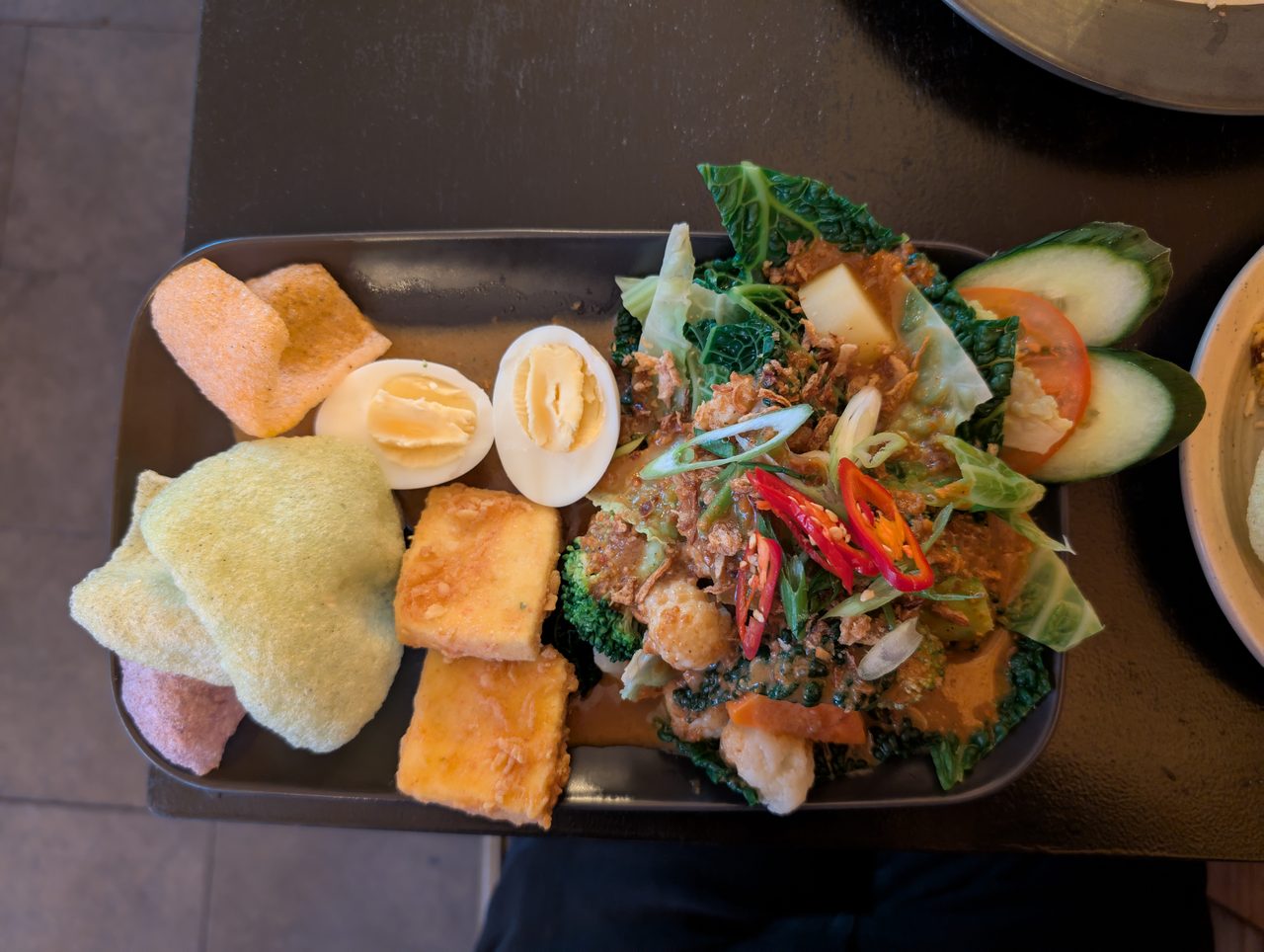
- Tempe goreng: brined and fried, which is the last step above and by far the commonest form. It is what the tempeh in gado-gado, nasi goreng and nasi lemak is.
- Tempe bacem: simmered in soy sauce, palm sugar, galangal and coriander until the liquid has gone, then fried. The sweet-salty Javanese version, and it keeps.
- Tempe mendoan: battered and fried. Wonosobo's tempe kemul is the famous one.
- Tempe menjes and tempe gembus: made from peanut presscake and from the okara left over from making tofu. The mycelium knits those just as well — what makes the mat is the mould, not the bean.
- Wrapped in banana leaf: the traditional way, and the one ko.wikipedia describes. The leaf is naturally slightly porous, so air gets in and the mould grows as far as the oxygen reaches; a few slits cut in it make that certain. That is what the photograph shows.
- Against natto: both ferment soybeans, but natto's organism is a bacterium and it makes threads and goes soft. This one is a mould and it makes a mat and goes firm. The ko.wikipedia entry puts it as being like cheonggukjang but firm rather than soft.
Tips
- The hyphae running deeper is the point. Fermentation basics has this under failures: fuzzy black, green or pink mould, discard it, because scraping the visible part off does not help — the hyphae run deeper. Tempeh uses exactly that property as its structure. Rhizopus grows between one bean and the next and knits a mat, which is how 400g of loose beans becomes one slab you can cut.
- It is the sixth binder on this site and the only living one. Sundae binds with blood, weisswurst with myosin the salt has drawn out, haggis with oatmeal that swells and stays discrete, crab cakes with egg and mayonnaise brought in from outside, and kamaboko with what is left after washing. Here the binder is the mould's own body.
- Miso's mould does a different job. As that page says, koji's mould manufactures enzymes and then stands aside — the enzymes work for months and the mould's body is mashed into the paste and gone. In tempeh the body stays and is what you eat. Same kingdom, opposite use.
- The air holes are not decoration. The guide's third lever is keeping air out, and the reason it works is that moulds need oxygen. This turns that lever around — though natto and miso have already made the same inversion, so it is not the new part here.
- Vinegar stands in for the salt. The guide's first lever is salt concentration, and there is no salt in tempeh at all. Keeping the wrong organisms out is done by the vinegar in the boiling water — a low pH instead.
- Dry surfaces or it fails. Bacteria win on wet beans. Spread the boiled beans on a cloth and wait until they feel dry to the hand.
- The starter cannot be substituted. Like the pearl sugar in kanelbulle, without it you do not get this food. Indonesian grocers and online shops sell it as ragi tempe.
- Black patches are normal. Blackening around the holes is the spores maturing and the flavour goes a little stronger with it. What you judge is not the colour but the smell: mushrooms is right, ammonia means throw it out. The same kind of distinction hongeo-hoe needed.
The basics behind this dish
- Fermentation Basics: Salt, Temperature, and AirFermentation is controlled spoilage. You control it with exactly three levers — salt, temperature, and keeping air out — and the failure signs are unambiguous.
- Building Umami: Glutamate, Synergy, and LayersUmami is built in layers, not added from one bottle. The key is synergy: glutamate plus nucleotides multiply each other rather than adding up.
- Fermented Pastes: Gochujang, Doenjang, Miso, and How to Use ThemA fermented paste is not a seasoning but a finished ferment. Why brands differ enough in salt that you season last, why paste scorches, and why miso must not boil while doenjang has to.
More of the same kind


More from this country



Sign in to edit.
AI-drafted, editor-reviewed · edits: 0 ·Edit history
https://cookiki.com/en/r/tempeh · cookiki · User contributions are licensed under CC BY-SA 4.0.