
Photo: Sarang · Public domain
Jeungpyeon (Rice Cake Leavened with Makgeolli)
The summer rice cake made by fermenting non-glutinous rice flour with makgeolli, and the only tteok on this site that rises. Fermentation basics explains a ferment as an acidity crash — lactic bacteria turn sugar into acid and the falling pH keeps spoilage out — and in jeungpyeon that acid is the by-product. What is wanted is the carbon dioxide the yeast gives off. And for that gas to be trapped at all it has to be a pourable batter rather than a dough: rice flour has no gluten, so there is no network to hold bubbles, and what holds them instead is starch setting around them as it steams. Which is why this is the one tteok nobody kneads.
Ingredients
- The batter (serves 8; one 20cm round tin)
- wet-milled non-glutinous rice flour · the damp kind from a rice mill; with dry flour add 30ml more water500 g
- makgeolli · unpasteurised and live, warmed to about 30°C200 ml
- lukewarm water150 ml
- sugar60 g
- salt0.5 tsp
- Toppings
- jujubes · stoned, peeled in a strip and rolled into flowers4
- chestnuts · thinly sliced3
- pine nuts1 tbsp
- black sesame1 tsp
- stone-ear mushroom · optional; soaked and cut into threads2 g
- If you fill them (the individual version in the photograph)
- sweet red bean paste · optional; divided into 15g portions200 g
- oil · for the knife and the moulds1 tsp
Steps
- ⏲ 5 min
Shake the makgeolli to mix it and warm it to about 30°C — lukewarm on the back of your hand; hot kills the yeast. It has to be the live, unpasteurised kind: heat-treated makgeolli has no live yeast in it and will not rise however long you leave it.
- ⏲ 15 min
Sieve the rice flour once, then mix in the makgeolli, lukewarm water, sugar and salt until smooth. What you want is a pourable batter, not a dough — thick, but it should fall from a ladle in an unbroken ribbon. Loosen it with a little more water if it is stiffer than that. Nothing is kneaded.
Cover it loosely with film or a damp cloth and leave it at 30-35°C for 4-5 hours, until it has doubled and the surface is covered in bubbles. Here you are waiting for gas rather than fighting mould, so unlike the ferments in fermentation basics there is no reason to shut the air out. In winter, use an oven proving setting or stand the bowl over a pan of warm water.
- ⏲ 30 min
Stir it down gently with a spatula to knock the gas out. That breaks up the big bubbles so the crumb comes out even; beat it hard and you lose the rise altogether. Cover it again and give it 30 minutes.
- ⏲ 15 min
Get a steamer up to a full head of steam. Line the tin, pour the batter in 2-3cm deep and scatter the jujube, chestnut, pine nuts, black sesame and stone-ear over it. For the individual filled version, half-fill small cups, add a portion of red bean paste and cover it with more batter.
- ⏲ 20 min
Put it in once the steam is up and steam 20 minutes with a cloth stretched under the lid. Without the cloth the drips off the lid blotch the surface — the failure described in steaming. A chopstick pushed in should come out with no batter on it.
- ⏲ 5 min
Turn off the heat and leave it 5 minutes with the lid on. A leavened batter collapses if the temperature drops abruptly.
- ⏲ 30 min
Lift it out, cool it completely, and cut it with an oiled knife. Cut warm, it drags on the blade and the bubble structure squashes flat.
Tips & Variations
Variations
- Why this is the only tteok that rises. Baekseolgi opens by saying there is no dough at all — damp rice flour sieved, piled into a mould, and steam gelatinising the starch where it lies. Songpyeon kneads a boiling-water dough and daifuku beats one. Jeungpyeon is none of those; it is poured. That is the only consistency that can hold gas.
- It pairs with injera. Both are gluten-free grain batters left to ferment, and where they part is the cooking. Injera is spread thin and cooked on one side, so the bubbles rise to the surface and break there and the holes stay open as the eyes. Jeungpyeon is steamed thick, so the bubbles are trapped inside and become the crumb. The same batter with its holes on the outside or on the inside.
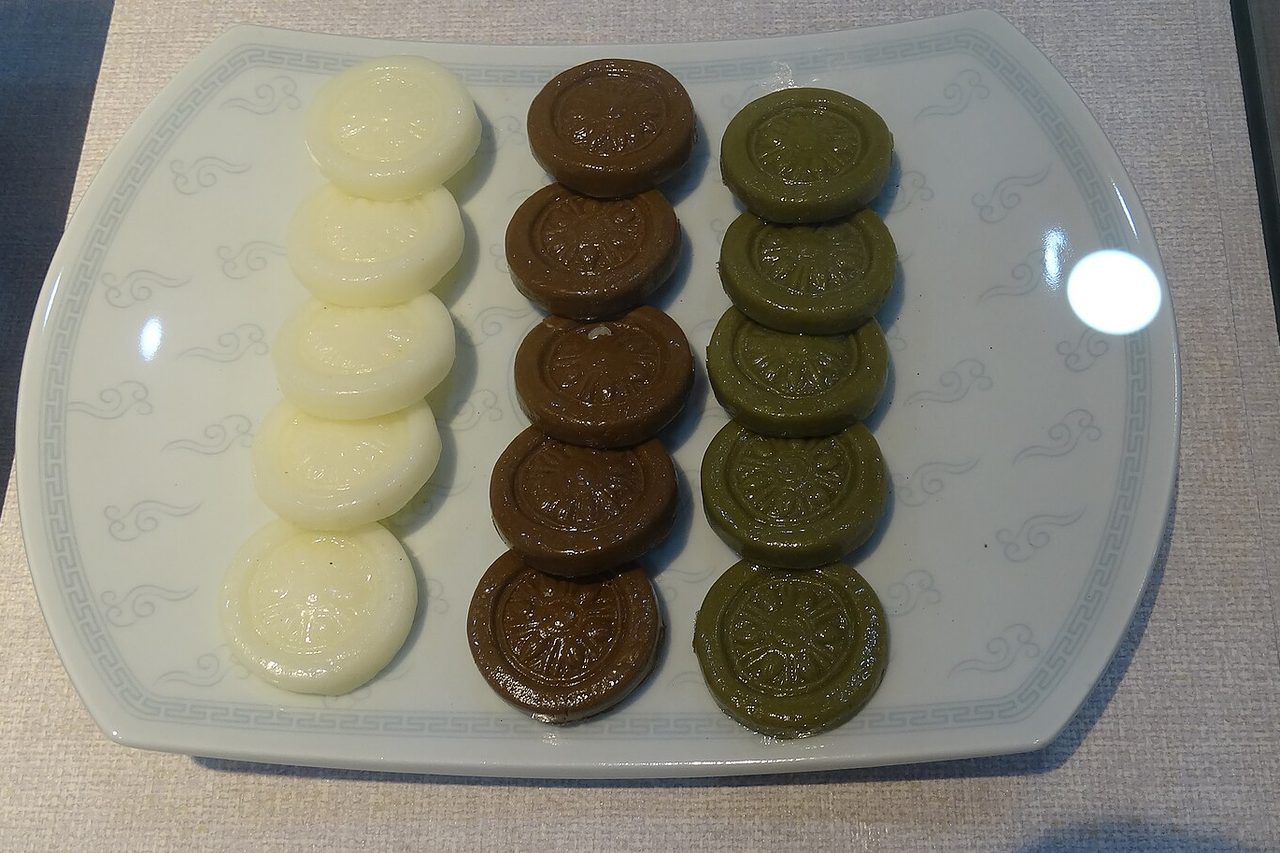
- The individual filled version is poured into small cups with a portion of red bean paste in the middle, and that is what the photograph shows. Regionally it is also called gijeungtteok, gijitteok, sultteok or beonggeojitteok.
- A descendant of sanghwa: the Goryeo-era cake that came from Yuan China was made with wheat flour, fermented with liquor, filled with bean paste and steamed. Jeungpyeon is the same idea moved onto rice — which is what puts starch in the job gluten had.
- Instead of makgeolli: 3g of dried yeast in lukewarm water does make it rise. But it removes the sourness and the wine note, which is most of what jeungpyeon is. Makgeolli carries yeast and lactic bacteria together, so it produces gas and acid at once.
- It is a summer cake. The sourness reads as cooling on a hot day, and the acid keeps it from going off quickly. Which is to say the preservation effect that fermentation basics treats as the main event arrives here as a side effect.
Tips
- Check that the makgeolli is live. Anything labelled pasteurised will not rise. Half the failures with this recipe are here.
- The consistency is the leavening. Stiff as a dough, the gas escapes sideways instead of being trapped. Keep it loose enough to fall from a ladle in a ribbon.
- Hold it at 30-35°C. At 20°C it takes ten hours, and past 45°C the yeast dies.
- Do not skip knocking it back. One stir gives you an even, fine crumb; steamed straight from the first rise, it sets with a few big holes near the top.
- In after the steam is up. Started in cold water, the batter slumps while the water heats.
- Cool it completely before cutting, and oil the knife.
- A day on it firms up a little and re-steaming brings it back. It does not go in the fridge — the reason is in daifuku.
The basics behind this dish
- Fermentation Basics: Salt, Temperature, and AirFermentation is controlled spoilage. You control it with exactly three levers — salt, temperature, and keeping air out — and the failure signs are unambiguous.
- Alcohol in Cooking: What It Actually DoesAlcohol is a solvent for aroma, it does not all cook off, mirin and sake and shaoxing and wine each do a different job, and there is a real substitution ratio when you have none.
- Steaming: Water Level, Condensation, and StackingSteam never exceeds 100°C and still cooks faster than boiling water. The reason is latent heat; the commonest failure is the drip off the lid; and stacking does not work the way people think.
More of the same kind


More from this country


Sign in to edit.
AI-drafted, editor-reviewed · edits: 0 ·Edit history
https://cookiki.com/en/r/jeungpyeon · cookiki · User contributions are licensed under CC BY-SA 4.0.