
Photo: Zheng Zhou · CC BY-SA 4.0
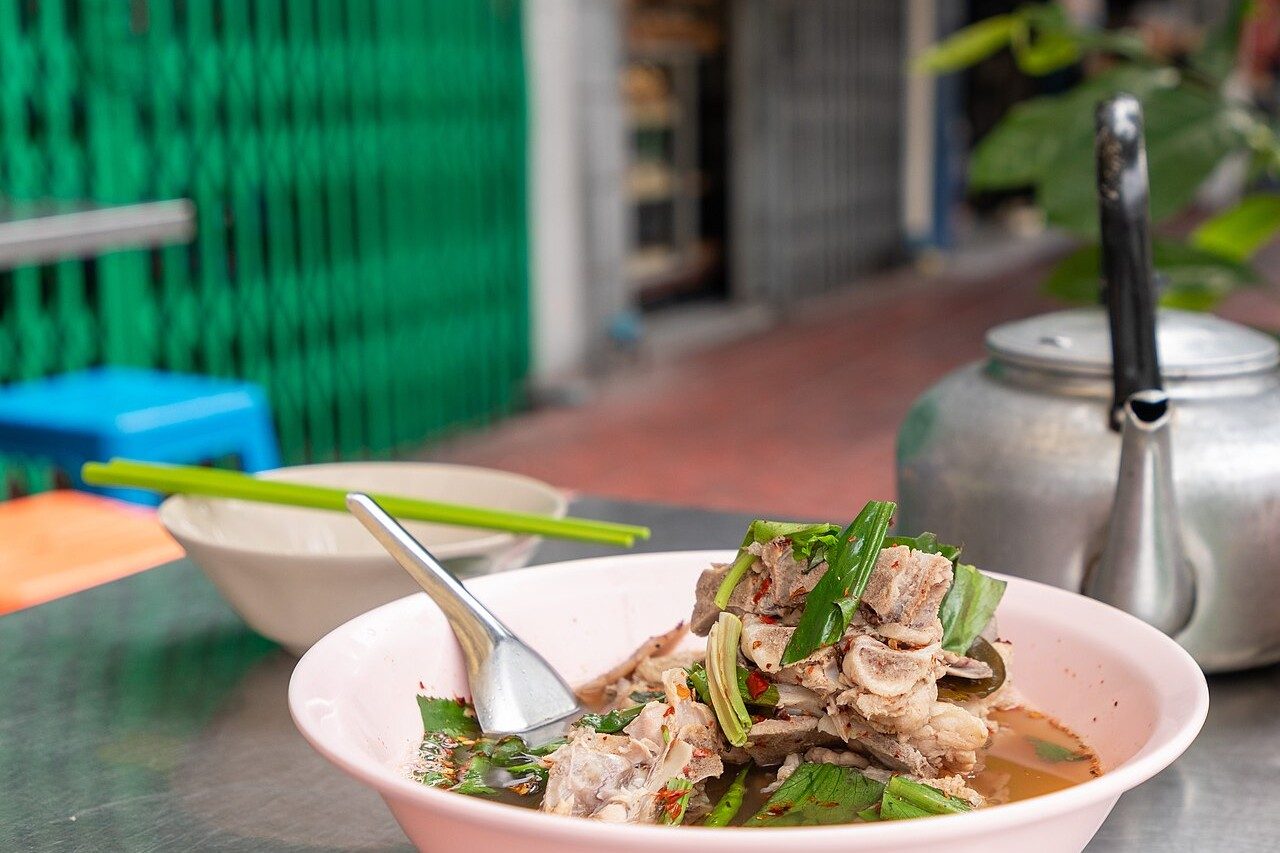
Kuaitiao Ruea (Boat Noodles in a Blood-Thickened Broth)
A Thai noodle bowl whose pork-bone broth is thickened by pouring pig’s blood into it. Where sundae puts blood in so that it will set, this dish needs it never to: once the blood is in, the broth must not boil again.
Ingredients
- Broth (serves 4)
- pork neck bones800 g
- water2.5 L
- onion1
- garlic6 cloves
- coriander roots · a handful of stalks if you have no roots3
- lemongrass1 stalk
- galangal3 slices
- pandan leaves · optional2
- cassia bark1 piece
- star anise2
- white peppercorns1 tsp
- light soy sauce3 tbsp
- dark soy sauce1 tbsp
- taucheo · fermented soybean; 1 tsp of miso stands in1 tbsp
- palm sugar1 tbsp
- To thicken
- pig's blood · food-grade, strained150 ml
- The bowls
- thin rice noodles · sen lek300 g
- beef · thinly sliced200 g
- beef balls12
- bean sprouts200 g
- water spinach · spinach works100 g
- Toppings
- fried garlic · with its oil4 tbsp
- pork crackling · kap mu1 handful
- Thai basil1 handful
- chilli vinegar · at the table4 tbsp
Steps
- ⏲ 15 min
Soak the pork bones in cold water to draw the blood out, then blanch 5 minutes and rinse.
- ⏲ 120 min
Simmer the bones with the onion, garlic, coriander root, lemongrass, galangal, pandan, cassia, star anise and peppercorns in 2.5L of water for 2 hours, then strain.
- ⏲ 5 min
Season with the soys, taucheo and palm sugar and get it right now — once the broth is thick it is hard to correct.
- ⏲ 3 min
Strain the blood once through a sieve. Poured in with clots, it sets in those spots and nowhere else.
- ⏲ 4 min
Take the broth down past the boil to around 80C, then pour the blood in as a thin stream with one hand while stirring with the other. The broth turns dark and opaque.
- ⏲ 2 min
Do not let it boil again. At the boil the blood sets into grains and separates out of the liquid. Hold it at a bare steam.
- ⏲ 5 min
Soak the rice noodles and blanch them 30 seconds; blanch the sprouts and water spinach 10 seconds. Put them in the bowls.
- ⏲ 4 min
Cook the beef and beef balls in the broth, lift them onto the noodles and ladle the broth over. Use small bowls — this is a noodle people eat several of.
- ⏲ 2 min
Top with fried garlic and its oil, pork crackling and Thai basil. Chilli vinegar goes on at the table.
Tips & Variations
Variations
- Without blood (nam sai): the clear-broth version, and it goes by a different name. The body goes with it, so do not cut the spices back or nothing is left holding the balance. This page is about the nam tok side.
- With pork: many shops use pork with liver and lung instead of beef. The base stock is pork bone either way.
- Other noodles: sen lek is standard, but sen yai (wide) and bami (Chinese wheat) are both used. A thick broth clings better to a thin strand.
- Why the bowls are small: it was sold from boats, two or three chopstick-loads at a time. Shops keep the size, and stacking the empty bowls to count them is part of the form.
- Haeng (dry): barely any broth, tossed instead of ladled. The thickness becomes the sauce.
Tips
- The blood is not here to set. It is here to do the opposite. Sundae writes down the other use of it: "The blood is a binder, not a flavouring. Its proteins coagulate with heat much as egg does, and that is what grips the noodles and vegetables." There coagulation is the goal; here coagulation is the failure**. Same protein, same heat — one dish sets it to grip, the other stops just short and leaves it dispersed through the liquid.
- The slot for that is already in thickening a sauce. That guide names one of its classes "Egg that thickens without setting." and describes blanquette de veau's as "yolk and cream let into the broth and never taken past 70°C". Blood belongs in that class and the guide simply never names it — blood instead of yolk, a whole pot instead of a liaison, and the same fact that there is a temperature you must not cross.
- So the discipline of the dish is entirely in steps five and six. Drop the heat before the blood goes in, and never bring it back to the boil after. Boiled, the broth does not thicken — it splits into brown grains and thin water, and no amount of stirring brings it back (cooking eggs).
- Sundae also explains the sieve. "Clots left in set into dense pockets" — and in a broth those pockets are simply grains floating in it.
- Season before the blood, not after. A thickened broth carries flavour differently and reads its own salt differently, and soy poured in late has to be stirred in, which is exactly the risk you have just spent two steps avoiding (salt and seasoning).
- Every topping being crisp is not an accident. Fried garlic, pork crackling, raw sprouts — the heavier the broth, the more the bowl needs something to break it up. Khao soi makes the same choice in the same country: fried noodles on top of a thick soup.
- Chilli vinegar at the table. Acid is what makes a thick broth read light, and added during cooking it boils away. Setting it bowl by bowl is how this noodle is eaten (balancing flavour).
The basics behind this dish
- Dough and Gluten: When to Build It and When to Avoid ItThe same flour and water becomes a dumpling wrapper or a tender pancake. The difference is whether you built gluten or avoided it — and kneading and resting do different jobs.
- Why Sauces Split: Emulsions and Pan SaucesA cream sauce breaking and a carbonara scrambling are the same failure. Temperature and emulsifiers — plus how to bring a split sauce back.
- Knife Skills: Grip, Cuts, and Why Size MattersHow you hold the knife matters more than how fast you cut. The pinch grip, the claw hand, and why uniform size is a cooking decision rather than a cosmetic one.
More of the same kind


More from this country


Sign in to edit.
AI-drafted, editor-reviewed · edits: 0 ·Edit history
https://cookiki.com/en/r/kuaitiao-ruea · cookiki · User contributions are licensed under CC BY-SA 4.0.